Get Full Government Meeting Transcripts, Videos, & Alerts Forever!
Get email alerts on the Public Safety topic
No spam. Unsubscribe anytime.
Titusville council approves five-year Axon in-car video contract amid privacy concerns
Summary
After extensive public questioning about privacy, data retention and automated license-plate readers, the council approved a five-year Axon Fleet 3 in-car camera agreement and associated budget amendment. Police said ALPR and live-stream capabilities help investigations; one councilor voted no.
The Titusville City Council approved a five-year agreement to purchase Axon Fleet 3 in-car video systems and authorized a related budget amendment following more than an hour of public comment and council questioning.
Police officials said the system will replace older equipment in patrol cars and that footage with evidentiary value will be retained under Florida statutory retention schedules. Lieutenant Josh Burn told the council that "LPR data ... is stored for 30 days. So the data is stored for 30 days and then it's gone," adding that footage tied to criminal cases is moved into evidence storage where state retention rules apply.
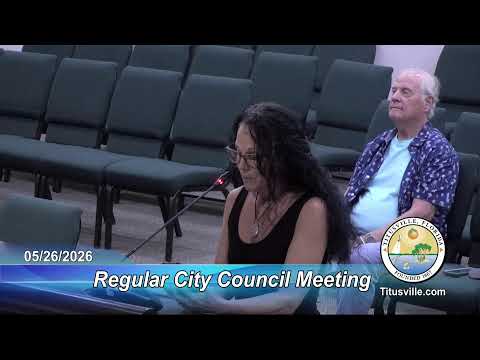
Residents urged caution about the cameras’ optional automated license-plate-reader (ALPR) capability and cloud storage. Elizabeth Parker, who spoke during the consent discussion, said she was concerned that aggregated cloud video could capture bystanders and private-property footage and asked how the city is protecting privacy. Multiple speakers asked whether the city or the vendor controls access and whether federal requests for data could bypass local controls.
Police representatives said the city maintains ownership and access control. The department described audit trails, restricted access for certain categories (for example, internal affairs footage) and automated alerts for irregular searches. Officer TJ Wright and Lieutenant Burn said the live-stream function can be used to check on officers during traffic stops and to reallocate resources when an officer is in distress.
Supporters pointed to recent cases in which camera technology helped locate missing or endangered people and aided criminal investigations. Lieutenant Burn described several recent recoveries and said the tools have been used in investigations involving stolen vehicles and violent crime.
Council member discussion acknowledged both public safety benefits and privacy concerns. Member Muscoso voted against the motion, citing unease about expanding ALPR capacity; other council members voted to approve the agreement. The motion carried with one no vote.
Council direction: staff will finalize the contract, and the city will proceed with deployment and policy enforcement as described by the police, including the stated retention and audit measures.