Get Full Government Meeting Transcripts, Videos, & Alerts Forever!
Get email alerts on the Energy Capacity topic
No spam. Unsubscribe anytime.
Brainerd City authorizes staff to seek 30 MW capacity extension amid projected 2030 shortfall
Summary
The Brainerd City Commission authorized staff to negotiate an extended capacity agreement with a not-to-exceed price of $7.50 per kilowatt-month to address a projected 30 MW capacity deficit in 2030; commissioners discussed alternatives including bonds and a peak-shaving plant.
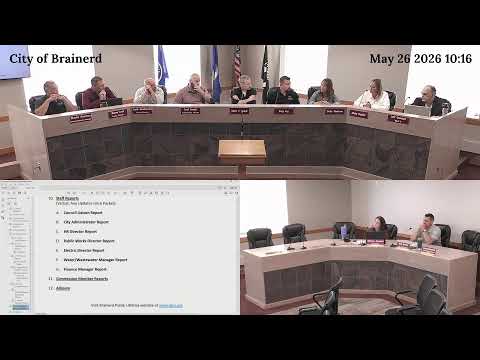
The Brainerd City Commission on May 26 authorized staff to negotiate an extended capacity agreement for up to 30 megawatts covering 2030–2040, with a not-to-exceed negotiation cap of $7.50 per kilowatt-month.
Danny, a city staff member who presented the generation and capacity update, told commissioners the city "has a capacity deficit of about 30 megawatts" projected in 2030 and described an auction opportunity to extend the city’s capacity. He said the city had requested $7.5 million in state funding for hydrogeneration but "did not receive any of our funding requests from the state," leaving officials to weigh alternatives including state funding efforts, issuing electric revenue bonds, or building a peak-shaving generator.
The move responds to a confluence of market pressures: staff said current capacity clearing prices are higher than historical levels (staff cited markets where prices are roughly double prior averages) and presented an option to cap negotiation authority at $7.50 per kilowatt-month to avoid open-ended exposure. Staff estimated customer impacts under one scenario, saying "it's $4.75 per month for just residential customers," and advised commissioners that costs could be phased into rates over several years to avoid a single large increase.
Commissioners asked how often capacity auctions appear (staff said annually and that 30-MW chunks are rare), whether large commercial users are driving demand, and how pursuing local generation would compare on cost. Staff noted peak-shaving plant estimates they’ve seen run higher (staff cited roughly $12 per kilowatt-month in preliminary figures) but emphasized that building local generation also carries siting, ordinance and capital costs.
With roughly a week to respond to the auction window, staff requested immediate authority to negotiate. A motion to approve negotiation authority up to the $7.50 cap was moved, seconded and approved by voice vote.
Next steps: staff will negotiate with market counterparties to attempt to secure the capacity tranche and will return to the commission with results and proposed rate-phasing options. The auction authorization does not finalize a purchase; it empowers staff to negotiate within the city-set ceiling.