Get Full Government Meeting Transcripts, Videos, & Alerts Forever!
Get email alerts on the Fire Department Budget topic
No spam. Unsubscribe anytime.
Fire commissioner tells council department handles about 1,000 calls a day, cites EMS staffing shortfalls and prevention plans
Summary
At a Committee of the Whole budget hearing, Fire Commissioner Jeffrey Thompson told council the Philadelphia Fire Department fields roughly 1,000 calls per day, outlined EMS workload increases and said the department is pursuing paramedic apprenticeships, upskilling, drones and expanded smoke-alarm work while acknowledging persistent staffing and minority-contractor challenges.
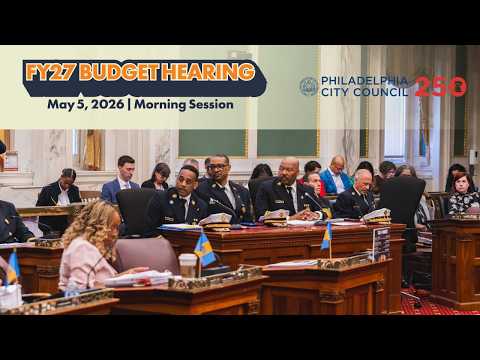
The Philadelphia Fire Department told City Council on the Committee of the Whole’s budget hearing that it responds to roughly 1,000 calls for service each day and is seeing growth driven mainly by emergency medical services, not structure fires.
"Philadelphia Fire Department continues to respond daily to approximately 1,000 calls for service per day," Fire Commissioner Jeffrey Thompson said in opening testimony, and he outlined prevention work, smoke-alarm installations, lactation pod placements at stations and a planned drone purchase to support operations.
Why it matters: Council members said the department’s workload and staffing figures affect response capacity, EMS run times and public-safety outcomes citywide as the council evaluates operating and capital budgets for FY2027.
Deputy Commissioner Martin McCall told the committee that the department’s total run time for calls is about 72 minutes and that transport calls average roughly 66 minutes; the department’s goal is to bring those transport calls below 60 minutes. McCall said hospital "wall time" — the time units spend waiting at emergency departments to transfer patients — is a major driver, and the department has created hospital liaisons and redirection policies to address the problem.
Councilmembers pressed the department on staffing and recruitment. In the hearing, McCall said "the number of paramedics that we currently have is 200." Later in the exchange officials discussed a budgeted paramedic target in the neighborhood of 360 and reported roughly 176 total EMS vacancies; McCall said the department’s shortfall specifically for paramedics is about 60 positions. The committee’s discussion included some back-and-forth as staff worked to reconcile how the counts are reported.
To address pipeline issues, Commissioner Thompson said the department is starting a paramedic apprenticeship and an upskilling program to elevate existing EMTs and EMT-advanced staff to higher certification levels, and plans to run two classes at a time later this year to accelerate hires off civil-service eligibility lists.
Minority contracting also drew questions. Council members noted SBE participation in Fire Department professional-services contracts declined from about 15% in FY25 to 11% in FY26 and to 5% in the first quarter of the current fiscal year. Margaret B. Morgan, the department’s fiscal officer, told the committee much of that shift reflected the concentration of certain technical vendors (for example, ambulance-related systems) and the limited vendor market for specialized services, and said the department will continue outreach through the Office of Equal Opportunity and Employment.
On prevention, Thompson described a growing GIS analytics unit and outreach efforts — school visits, camps and open houses in each councilmatic district — and said the department is installing smoke alarms citywide while using data to target high-risk areas. Councilmembers asked for neighborhood- and district-level breakdowns of fire incidents and for a timeline and plan to expand visible prevention campaigns; Thompson and deputies said they would provide the data and asked council to consider additional resources for a broader campaign.
Deputy Commissioner McCall also reported a significant decrease in "zero-medic" occurrences year over year after implementing availability and diversion policies, and he said the department will provide more detailed day-by-day reporting on those events on request.
The department closed its testimony and council moved to a callbacks session to question other administration departments later in the day. Staff said they will return with requested breakdowns of incident locations by council district, paramedic vacancy reconciliations and more detailed smoke-alarm backlog figures.