Get Full Government Meeting Transcripts, Videos, & Alerts Forever!
Get email alerts on the Infrastructure Finance topic
No spam. Unsubscribe anytime.
City sustainability manager previews possible $300 million infrastructure bond to address Alameda’s aging roads, storm systems and sea‑level risks
Summary
Danielle Mueller, Alameda’s sustainability and resilience manager, told the Transportation Commission that city workshops identified more than $800 million in infrastructure needs and that a $300 million local bond is one option under consideration to fund roads, storm drains, backup power and shoreline resilience.
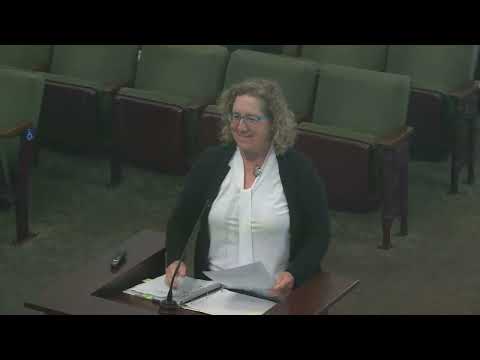
Danielle Mueller, Alameda’s sustainability and resilience manager, told the Transportation Commission on May 20 that the city has identified more than $800 million in urgent infrastructure needs and is seeking community input on financing options, including a possible $300 million local bond.
Mueller said the $800 million estimate covers aging roads, bridges, storm drains and public‑safety facilities that the city says are increasingly vulnerable to severe storms, sea‑level rise and major earthquakes. She told commissioners the bond would be a dedicated funding source to pay for repairs, storm‑mitigation projects, backup power for critical bridges and facilities, and improvements to stormwater systems to reduce bay pollution.
“If approved, property owners would pay approximately $49 for every $100,000 of assessed value,” Mueller said, noting that assessed value—not market value—is used in the city’s example. She gave a hypothetical: a property with a $500,000 assessed value would see roughly $249 per year under the cited estimate.
Mueller emphasized local control and oversight: she said funds would remain in Alameda and be overseen by an independent citizens’ oversight commission. She also cited recent local examples of infrastructure failures — including extended outages and January king‑tide flooding — to explain why the city is exploring a dedicated revenue source.
Mueller encouraged residents to review mailed informational materials and complete the online survey at the city web page she referenced for public input on priorities and projects.
The presentation to the Transportation Commission was framed as an informational update on community engagement; no formal action or recommendation from the commission on the bond appeared in the record during this meeting. If the city formally places a bond measure on a ballot in the future, the commission or other city bodies could be asked to review project lists, expected costs and oversight measures before placement.