Get Full Government Meeting Transcripts, Videos, & Alerts Forever!
Get email alerts on the Alpr Surveillance topic
No spam. Unsubscribe anytime.
Cheektowaga board tables proposed expansion of Flock license-plate readers after public privacy concerns
Summary
After a lengthy public-comment period and extended board debate, the Town Board of Cheektowaga voted to table a resolution to amend its agreement with Flock Group to add two ALPR cameras, citing unresolved questions about data ownership, vendor security, placement, and recurring costs.
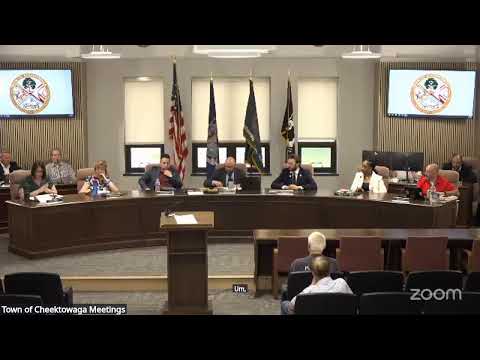
The Town Board of Cheektowaga on May 26 tabled a resolution to amend its agreement with Flock Group Inc. to add two fixed automatic license-plate reader (ALPR) cameras amid sustained public concern about privacy, vendor security and data-sharing practices.
Residents and board members pressed for more information after several public speakers described FOIL requests that went unanswered, questioned who owns or controls data captured by Flock, and highlighted audits showing searches sometimes lacked clear justifications. ‘‘The FBI is going to have access to the nation’s ALPR cameras across the United States,’’ warned one public commenter, urging the board to pause expansion until legal and operational questions are answered. Another resident testified that ALPR placement has been concentrated in non‑white neighborhoods.
Chief of Police (name not provided in the record) told the board the system is ‘‘an investigative tool’’ rather than ‘‘mass surveillance,’’ said the department audits Flock use monthly, and stated that the town ‘‘owns the data’’ and retention is set at 30 days. The chief cited several recent criminal investigations where ALPR data assisted arrests, including interstate vehicle theft and a missing‑person case.
Board members acknowledged the tool’s usefulness for investigations but said the town needs clearer vendor security assurances, transparency about who may query the database, and more precise local policies on retention and release. Council member Noiki (spelling in the transcript varies) summarized the tradeoffs: the system can help solve crimes but also creates a cost in public privacy if left unchecked.
Supervisor Brian Noak and others proposed next steps including further review, clarification of recurring costs and sharing arrangements, and a community forum to allow residents to ask questions and see demonstrations. On a motion by Council member Noviki and second by Council member Elder, the board voted to table resolution 2026‑342 to allow for additional information and discussion before approving the equipment purchase.
The resolution under consideration would have added two flat cameras at an estimated one‑time cost of about $10,000 plus implementation fees reported in the packet; speakers also asked whether that addition would increase the town’s annual recurring cost lines already reported elsewhere in the materials.
The board did not adopt the amendment; the measure was tabled for future consideration.