Get Full Government Meeting Transcripts, Videos, & Alerts Forever!
Get email alerts on the Drone Delivery topic
No spam. Unsubscribe anytime.
Nampa planning panel approves Amazon Prime Air launchpad CUP; FAA approvals and environmental review remain required
Summary
The commission approved a conditional use permit for a fenced Prime Air launch/charging pad at Amazon's Boyd 2 fulfillment center to support drone deliveries (12–15 Mark 30 drones initially), subject to FAA airspace authorization, NEPA environmental review, a local contact for complaints, and several city conditions.
The Nampa Planning & Zoning Commission on May 26 approved a conditional use permit for Amazon to install a fenced drone launch and charging area (a “paddic”) at its Boyd 2 fulfillment center at 5295 East Franklin Street, clearing one major local land‑use hurdle for Prime Air operations while leaving federal approvals and environmental review to be completed before any flights.
Sam Bailey, senior manager for economic development policy at Amazon, described the proposed operation: a fenced paddic in the western parking lot, battery vaults and charging infrastructure, and 12–15 Mark 30 drones staged at the site. Bailey said the Mark 30 is an FAA‑regulated drone used in multiple U.S. markets; it carries smaller parcels, flies between 200 and 400 feet in eligible airspace, and drops packages from a hover of about 12–13 feet rather than landing on private property. Customers must opt into the service at checkout.
Bailey and staff emphasized that local land‑use approval is one of several necessary steps. Amazon still must secure FAA airspace authorizations and complete a National Environmental Policy Act (NEPA) environmental assessment (a Finding of No Significant Impact is required where applicable) before commencing operations. The company also said it will coordinate directly with Nampa Municipal Airport and local first responders and that police or fire can request immediate temporary suspension or no‑fly zones during incidents.
Public testimony included concerns about noise, privacy and potential effects on wildlife, including migratory birds near Lake Lowell. Amazon cited a third‑party sound study from another market (measuring 61–68 dB at delivery points in daytime conditions) and said its drones are equipped with detection‑and‑avoidance systems and limited navigation cameras used only for safe operation, not continuous surveillance.
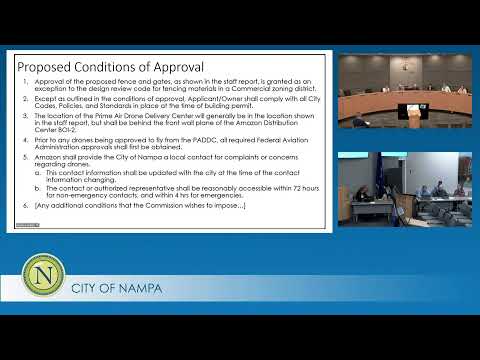
Planning director Rodney Ashby presented staff’s recommended CUP conditions, including an exception to standard commercial fencing rules to allow the proposed secure paddic, and a requirement that all required FAA approvals and environmental reviews be obtained prior to any flights. Amazon must provide a local complaint contact and keep city staff updated; the contact must be accessible for emergency response within a short timeframe and for non‑emergency inquiries within 72 hours.
Commissioners discussed the limits of local authority versus FAA preemption of navigable airspace but concluded the commission retained land‑use authority over takeoff/landing sites and on‑site infrastructure and could impose operational conditions. On a majority vote the commission approved the CUP. Staff noted the standard 15‑day written‑decision/appeal period.
Next steps: Amazon must complete FAA coordination, NEPA environmental work and any airport‑requested mitigations before establishing active drone flights; the city and Amazon will continue community outreach and interjurisdictional notice for residents and neighboring jurisdictions within the service area.