Get Full Government Meeting Transcripts, Videos, & Alerts Forever!
Get email alerts on the Lead And Copper topic
No spam. Unsubscribe anytime.
Town staff outlines plan to meet new EPA lead-and-copper inventory deadline, warns of many 'unknown' service lines
Summary
Town staff told commissioners the EPA's 2021 Lead and Copper Rule requires a public inventory due Oct. 16, that the town currently has few documented lead lines but roughly 3,000 customer-side 'unknowns,' and that mailings and testing requirements could create significant outreach and budgetary work.
Brent, a town staff member, told the Town Board at its workshop that the Environmental Protection Agency's 2021 revisions to the Lead and Copper Rule require a detailed, publicly accessible inventory of all water service lines — including the customer side — and that Hillsborough must submit that inventory to the state by Oct. 16.
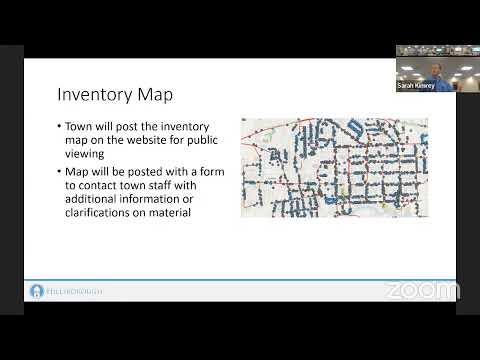
"We are required to present this inventory to the state by October 16th," Brent said, explaining the requirement to classify service lines as lead, galvanized requiring replacement, non-lead or unknown and to rely on evidence-based records or field verification for assumptions. He said the town will post the inventory and related maps on the town website.
Why it matters: the rule expands what utilities must track and triggers notifications to customers. Brent said the town has "no documented history of lead service lines" but about "3,000 unknowns" on the customer side out of roughly 7,000 services. Because of that uncertainty, many residents will receive mandated notices even if their lines are likely not lead.
The notices must be sent within 30 days of the inventory submission to people whose services are classified as lead, galvanized requiring replacement, or unknown. Brent said staff will include contextual language developed with the communications team to reduce undue alarm, but acknowledged the notices contain statutory wording the town must include.
Staff described verification options and likely costs. Brent recommended a mix of outreach to encourage residents to self‑verify (uploading photos or documents) and selective contracted field verification. He estimated that neighboring municipalities see field verification costs of roughly $300–$400 per service and that verifying several hundred sites could reach six figures. "If we have to do three or 400 services you're looking at well into six figures for a contract," he said.
Brent said the state allows statistical extrapolation once a verified sample reduces unknowns, which is one reason the town plans a multi‑year approach. The rule also requires supplemental testing beginning January for licensed child‑care centers and for any known lead service lines added to the testing pool, prompting staff to budget for increased sampling.
Board members asked how notifications will be addressed for tenants and multifamily properties; Brent said the mail merge will use the billing account address, meaning account holders (often property owners) will receive notices and are expected to convey information to tenants. Town‑owned facilities that predate the 1986 lead ban — including the historical museum and a cemetery fountain staff noted — will be tested and notified if classified as unknown or lead.
Staff emphasized operational limits: the town is building the inventory largely from disconnected records and without a one‑to‑one GIS link to asset management, and they will need time and resources to reduce the unknown category before the replacement phase begins. Brent said the town has a three‑year window to refine the inventory, after which a 10‑year replacement schedule (10% per year) would apply to known lead service lines. He urged outreach to improve resident response and reduce expensive field verification needs.
Next steps: staff launched a public lead‑information page and expects the first formal mailers soon; they will continue outreach, pursue limited field verification, and return to the board with budget implications if additional funding becomes necessary.
(Reporting note: quotes and attributions come from the town staff presentation at the board workshop.)