Get Full Government Meeting Transcripts, Videos, & Alerts Forever!
Get email alerts on the Harmful Algal Blooms topic
No spam. Unsubscribe anytime.
TDEC launches live HABs dashboard, expands monitoring and outreach as Tennessee reports three confirmed blooms in 2026
Summary
Tennessee Department of Environment and Conservation rolled out a live harmful algal bloom (HAB) dashboard and story map, hired a HAB specialist, partnered with Tennessee Tech for quantitative toxin testing, deployed field screening kits in eight offices, and reported nine complaints with three confirmed HABs so far in 2026.
Jessica Rader, harmful algal bloom lead at the Tennessee Department of Environment and Conservation, told the Tennessee One Health Committee that TDEC launched an updated HABs website and a live dashboard in March to make reports and advisory status visible to the public. "We had nine algal bloom complaints received. Of those we had three confirmed HABs," Rader said, noting that the dashboard displays reported conditions, precautionary advisories and NO contact advisories.
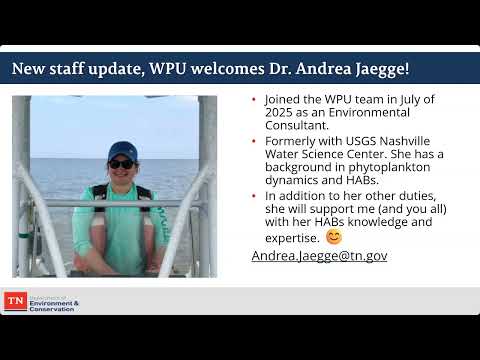
Rader said TDEC recently added staff support for the program, naming Andrea Jaegge, PhD, who joins from the USGS Water Science Center, and will work with TDEC and the Department of Health on HAB response. The dashboard and associated story map allow members of the public to submit photos and location information via a survey-based report form; submissions automatically notify both TDEC and the Tennessee Department of Health Waterborne Health unit.
Rader described the dashboard's advisory-color system: newly reported events appear gray while investigations are pending, yellow indicates precautionary advisories, red indicates NO contact advisories, and green indicates a cleared or non-HAB determination. She said the dashboard and story map also host visual guides and links to CDC and USGS resources to help the public distinguish cyanobacteria (which can produce toxins) from common filamentous algae.
TDEC reported a low-level microcystin detection at Beaver Lake in Shelby Farms Park that prompted a precautionary advisory which was later lifted after additional testing; Rader said one human illness was reported but determined not to be HAB-related. She cautioned the committee that ongoing drought conditions are likely to increase reports of shallow-water filamentous algae because lower, warmer and more stagnant water favors algal growth.
To strengthen testing capacity, Rader said TDEC will use a quantitative ELISA method through a partnership with the Tennessee Tech Water Center and has purchased microcystin screening kits for eight TDEC field offices to speed initial screening. If screening indicates microcystin, samples will be sent to Tennessee Tech for quantitative analysis to assess risks to recreation and water supplies.
Rader described TDEC's prioritization: complaints tied to jurisdictional waters used for drinking or recreation, or reports involving sick people or animals, will receive higher priority. She also outlined outreach and education work, including new awareness signs, participation at One Health Zoo Day and Earth Day events, planned talks at the Tennessee Aquarium and drinking water operator continuing education, and an upcoming MTSU graduate student internship to develop one-health-focused communication materials for TDEC and TDH.
"When in doubt, stay out," Rader said, urging the public to avoid contact with suspicious water. The committee thanked Rader and Amanda Goff of the Tennessee Department of Health, who was present and available for questions. The committee did not take formal action on HAB policy during this meeting; Rader laid out monitoring, reporting and outreach steps that the agencies intend to pursue in the coming months.