Get Full Government Meeting Transcripts, Videos, & Alerts Forever!
Get email alerts on the Utility Interconnection topic
No spam. Unsubscribe anytime.
Public Service Commission advances emergency interconnection rules to accelerate renewable and storage project timelines
Summary
The Public Service Commission voted to forward RM94, a package of emergency interconnection regulations designed to shorten study and construction timelines, expand pre-application reporting, tighten queue and invoicing transparency, and allow temporary, limited operation so projects can meet federal tax-credit deadlines through the end of 2027.
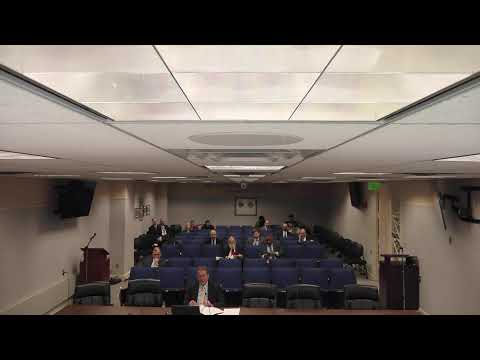
The Maryland Public Service Commission on a unanimous roll call advanced an emergency set of interconnection rules (RM94) aimed at speeding the pipeline for renewable-energy and energy-storage projects.
John Bowski, the interconnection work-group leader, framed the package as measures to shorten key interconnection deadlines created in Commission Order No. 91984 (PC73). "An emergency regulation is temporary until replaced by a full rule making," Bowski said, adding that permanent regulations will return to the commission for approval within the statutorily required timeframe after emergency treatment.
Why it matters: Stakeholders said the proposals are intended to help developers meet federal renewable-energy tax-credit deadlines that extend through late 2027 by cutting administrative delay points in the interconnection process. Key measures in the emergency package include expanded pre-application reports (an optional enhanced, fee-based version that provides more circuit and feeder detail), codified 30-day invoicing for study-related charges with a process to remove projects that fail to meet payment milestones, standardized study templates for complex (level-four) analyses, and new options to permit limited or temporary operation while upgrades are completed.
What the commission adopted and why: The package makes a number of timeline-focused changes. It requires clearer pre-application information so developers can site projects with fewer speculative studies; it authorizes utilities to combine certain study phases when appropriate to reduce duplication; and it sets rules for invoicing, queue reporting and site-control documentation. Developers and some commissioners pushed for more granular "available rated capacity" data for feeders and lines in addition to hosting-capacity maps; utilities said that data exists but adding it into automated public displays will take system work and may require temporary waivers.
Storage and minor-equipment changes: Developers urged that battery additions that do not increase export capability or affect safety be treated as "minor equipment modifications" so projects need not restart full interconnection studies. "If the battery does not increase net system capacity...it should be considered a minor equipment modification," said Dexter Hendris of the Coalition for Community Solar Access. Utilities and other commenters said some storage installations still require specialized study because of charging/discharging profiles.
Temporary permission to operate (TPO): RM94 establishes a TPO mechanism to allow projects to begin limited operations—typically non-export or capped export modes—while necessary system upgrades proceed, enabling compliance with tax-credit commercial-operation deadlines. Utilities asked for guardrails to ensure that studies and safety reviews are completed before any expanded export capability is permitted; staff proposed clarifying language to protect distribution reliability while preserving the time-limited TPO tool.
Queue, site control and transparency: The package tightens queue-management practices: utilities must track and make queue data available (spreadsheets on request or via staff-hosted data if necessary), identify withdrawn projects rather than silently removing them, and implement a clearer site-control certification approach. The commission directed the work group to develop a commission-approved certification form (stakeholders proposed adapting New York's form) so projects entering the queue demonstrate a minimum level of maturity while limiting burdens on landowners.
Stakeholder positions: Potomac Edison (PE) filed a scope objection on several sections, arguing they exceed the underlying PC73 directive and should follow standard rulemaking rather than emergency treatment. Developers and consumer advocates generally supported emergency action for most items but asked that certain contested provisions be revisited in the permanent rulemaking.
Next steps and vote: Chair Barbie moved to forward the revised emergency COMAR sections (the 20.50.09 series) to the Maryland Joint Committee on Administrative, Executive and Legislative Review for consideration; the commission approved the motion by roll call, with Chair Barbie and all commissioners voting in favor. Bowski said permanent regulations will be returned for the commission's review within the timeframe required after emergency adoption. The commission also requested a bench data request to quantify projects submitted to interconnection queues after Nov. 14, 2024, to help frame retroactivity and speculative-entry concerns.
What remains unresolved: Parties agreed to pursue some contentious items—detailed hosting-capacity publication timelines, specific line-rating disclosures and certain energy-storage study standards—through the work group and in the permanent-rulemaking phase rather than in the emergency text. Utilities flagged that some publishing and IT work will require transitional waivers or schedule commitments so they can meet the new public-reporting expectations.
The commission’s action forwards emergency regulatory text; the rules take effect on the emergency timetable but will be revisited for permanent adoption in the coming months.