Get Full Government Meeting Transcripts, Videos, & Alerts Forever!
Get email alerts on the Infrastructure topic
No spam. Unsubscribe anytime.
HCDA gets update on Kūlani (Puʻunene) infrastructure plan; members flag water, traffic and funding concerns
Summary
At a March 25 special meeting, the Hawaiʻi Community Development Authority received an update on planning and infrastructure options for the Kūleʻekuʻu/Puʻunene district, including two road build alternatives, water constraints, rough-order construction costs and next steps to seek legislative guidance.
Sterling Keiga, chairperson of the Hawaiʻi Community Development Authority, called the Kūlani special meeting to order March 25 and heard an informational update on planning, design and potential construction of infrastructure in the Kūleʻekuʻu (Puʻunene) Community Development District.
Craig Nakamoto, HCDA executive director, told the board the district covers roughly 988 acres and that Act 190 (2022) tasked HCDA to coordinate redevelopment planning and infrastructure for the area. Nakamoto said HCDA’s initial appropriation for planning and early construction work is $64 million but that total rough-order construction costs “exceeds 500 million dollars,” which would require phased funding and further legislative decisions.
The presentation outlined contract and schedule details: an RFP was issued in 2023, a notice to proceed was issued in June 2024 on a three-year contract with two one-year extension options, and deliverables to date include a communication plan, a planning assessment report (PAR) and an infrastructure master plan. Nakamoto said the PAR establishes baseline conditions and that water availability and the politics of water are “going to be a key challenge for future development.” He said the County of Maui is planning a new wastewater treatment plant expected to be complete around 2030, a timing factor for the district’s build-out.
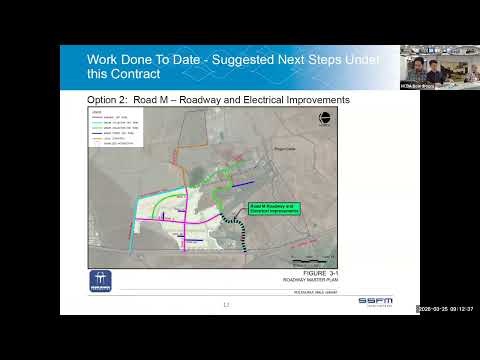
Staff described two candidate construction projects that might be advanced under the current contract: Option 1 (Road A) with a rough-order cost of about $39 million and Option 2 (Road M) at about $45 million. Nakamoto said Road M “makes the most sense” because it would provide greater access to nearby facilities including the armory, Raceway Park and the veterans home (the VA home), and because those uses better support potential relocations that have been discussed.
Nakamoto said HCDA plans to contract with Interra for additional hydrogeological assessment work to evaluate water supply and the possible use of R1 recycled water. He also said a communications plan remains in development to guide outreach when construction is considered.
Board members focused questions on traffic and cost exposure. Member Yamasaki asked whether Road M would require highway improvements at the Veterans Highway intersection, such as a traffic signal or an overpass. According to the presentation, preliminary studies contemplate a traffic signal, lighting and related electrical work and the consultant expects to investigate community impacts. “The cost that you see there in the ROM, it includes that,” a staff member said referring to the road estimate.
Member Cabibi, also speaking as a South Maui resident, said a traffic signal likely makes sense and suggested technical approaches that keep a light inactive until traffic volumes justify activation to reduce community concern. Staff said the outreach consultant Munekiyo will lead community engagement and evaluate whether a signal raises other issues that would alter the plan.
No members of the public registered to provide oral testimony and public testimony was closed. Earlier in the agenda the board approved the minutes of the Dec. 4, 2024 regular meeting with no corrections recorded.
Nakamoto said the team needs timely direction from legislative champions to determine whether and when to proceed to construction given rising construction costs and limited funds; he suggested convening a preliminary board meeting after legislative feedback to chart next steps. The board adjourned the special session at 9:19 a.m. and planned to reconvene at 9:30 a.m. for the general authority meeting.
Next steps: staff will seek legislative feedback, commission Interra’s hydrogeological assessment, complete outreach planning with Munekiyo, and return to the board with a recommended direction and schedule for any potential construction contract.