Get Full Government Meeting Transcripts, Videos, & Alerts Forever!
Get email alerts on the Ukraine Conflict topic
No spam. Unsubscribe anytime.
UN official says violence in Ukraine "worse than ever," urges immediate ceasefire
Summary
At a U.N. briefing, Rosemary DiCarlo cited OHCHR casualty figures, damage to Ukraine's energy and transport infrastructure, nuclear safety risks at Zaporizhzhia, and Independent Commission findings that deportations of children may amount to crimes against humanity; she urged an immediate ceasefire and accountability.
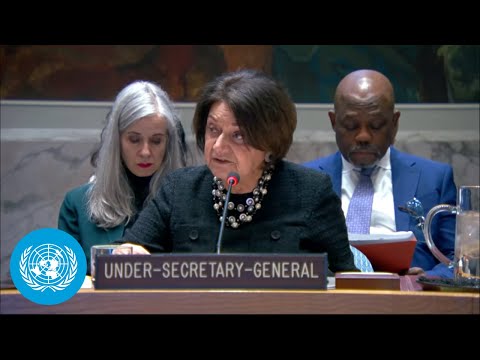
Rosemary DiCarlo, a U.N. official, told the assembly that more than four years after Russia's full-scale invasion the violence in Ukraine "is worse than ever" and called for a full, immediate, and unconditional ceasefire.
DiCarlo said the Office of the High Commissioner for Human Rights has verified 15,364 civilian deaths, including 775 children, and 42,144 civilians injured, including 2,588 children, since February 2022; she added the true toll is likely higher. She also warned that February saw at least 188 civilians killed and 757 injured, a 45% increase from the same period last year.
The briefing cataloged recent strikes across Ukraine: a 7 March strike on a residential building in Kharkiv that reportedly killed at least 10 civilians, strikes in the Kyiv region on 13'14 March, and attacks on Donetsk, Kharkiv and Kherson Oblast on 20 March. DiCarlo said transport infrastructure has been hit repeatedly, citing attacks on railways in Mykolaiv and Odessa on 4 March and drone strikes on passenger trains in Sumy on 8 and 14 March.
She warned that damage to Ukraine's energy infrastructure over the winter pushed the grid to the brink of collapse. Citing Ukrainian authorities, she said about 60% of gas production capacity has been destroyed and power stations have been damaged, producing persistent disruptions in electricity, heating and water services. DiCarlo said repairs will require time and "concerted international support."
On nuclear safety at the Zaporizhzhia plant, DiCarlo noted that successful repairs to power supplies were carried out on 5 March under a local ceasefire negotiated by the International Atomic Energy Agency and commended the IAEA's role in ensuring safety.
Citing the Independent Commission of Inquiry on Ukraine presented 12 March, she said the Commission concluded that "Russian authorities have committed the crimes against humanity of deportation and forcible transfer, as well as of enforced disappearance, both targeting children." DiCarlo said, "All deported children must be returned home without delay. Their rights and identity must be fully protected."
She also welcomed recent prisoner exchanges that returned 657 Ukrainian and 657 Russian prisoners of war in February and March and called for expansion of such measures. DiCarlo flagged regional consequences, saying damage to the Novodnistrovsk electro-hydroelectric plant on 7 March caused an oil spill and water pollution on the Dniester River in Moldova, prompting a 15-day environmental alert and disruptions to water services.
DiCarlo closed by saying the longer the war continues the deadlier it becomes and that international efforts should aim for "a just, lasting, and comprehensive peace in line with the U.N. Charter, international law, and relevant U.N. resolutions" that uphold Ukraine's sovereignty and territorial integrity. The presiding officer thanked DiCarlo for her briefing and gave the floor to Mr. Tom Fletcher.