Get Full Government Meeting Transcripts, Videos, & Alerts Forever!
Get email alerts on the Water Conservation topic
No spam. Unsubscribe anytime.
Parks department outlines water-conservation plan as region faces abnormally dry conditions
Summary
Sharon Hari of the Department of Neighborhoods told the council the region is in D0–D1 drought conditions, recommended irrigation upgrades and turf conversions, and outlined pilot projects, partnerships and public demonstrations to reduce outdoor water use.
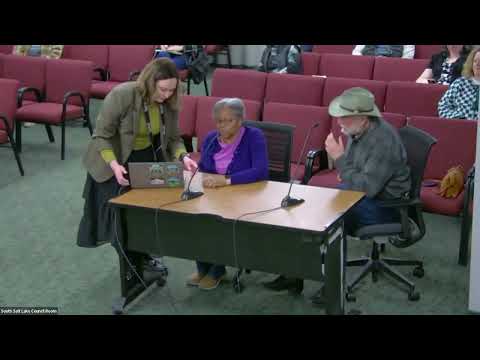
Sharon Hari, representing the Department of Neighborhoods, told the South Salt Lake City Council on March 11 that the region is facing abnormally dry to moderate drought conditions and outlined a parks-focused water-conservation plan designed to stretch the city's supply.
Hari cited the U.S. Drought Monitor (March 5) showing D0–D1 conditions locally and said the city must plan for lower-than-normal snowpack and precipitation this season. She described the department’s role as both a water user (parks and facilities) and a water utility customer and summarized a several-part approach: inventory and repair irrigation systems, swap standard spray heads for MP rotator nozzles to realize roughly 25% water savings in affected areas, set baselines and monitor usage with "Eye on Water," and prepare a drought prioritization plan to allocate watering across parks and public spaces.
The department plans three demonstration or conversion projects in 2026, will send staff to qualified water-efficient landscaper training, and will partner with Jordan Valley Water, Slow the Flow and Utah State University to promote incentives such as LocalScapes rebates and low-water landscaping resources. Hari urged residents to prioritize tree watering over turf, reduce watering schedules, use available rebate programs, and consider turf conversions; she also encouraged attending a hands-on demonstration at an upcoming community event.
Council members suggested visible signage where parks look intentionally brown to help public understanding; Hari and staff agreed to use demonstration sites and outreach to model alternatives.
The presentation was informational; no regulatory action was taken at the meeting.