Get Full Government Meeting Transcripts, Videos, & Alerts Forever!
Get email alerts on the Police K9 topic
No spam. Unsubscribe anytime.
Mount Vernon council approves purchase of police K9 and vehicle after hours of debate
Summary
The Mount Vernon City Council approved Resolution 1094 authorizing the purchase of a police canine and dedicated vehicle, amid public opposition and council debate over policy, timing and alternative uses for the $100,000 budgeted in the 2026 general fund.
The Mount Vernon City Council voted to approve Resolution 1094 on April 8, authorizing the purchase of a police canine and a dedicated, climate-controlled K9 vehicle funded in the 2026 general fund budget.
Finance Director Dougalleski told the council the canine program was budgeted in the 2026 adopted general fund and would replace a retired animal; costs include a professionally trained narcotics- and tracking-capable dog, a dedicated vehicle with safety features and handler training. He said the vehicle procurement would use the Washington State bid process and that available vacancy-savings in the general fund made the purchase feasible.
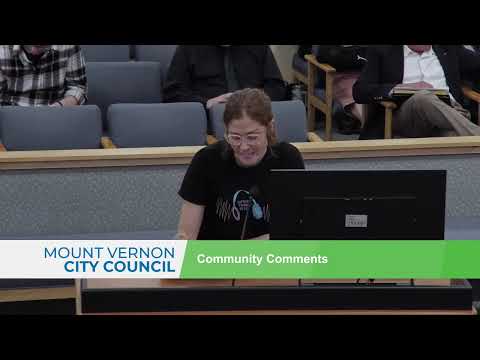
The measure drew lengthy public comment and council discussion. Resident Andrea asked the council "not to use our finite resources for a canine unit," saying the city faces other pressing needs, including library reopening, sidewalks and affordable housing. Resident Nicholas Levay told the council, "These dogs are weapons. They're not tools for safety." Several speakers urged the council to invest in prevention rather than additional police resources.
City Attorney Kevin Rogerson summarized a legal review provided through the Washington Cities Insurance Authority (WCIA), saying an outside attorney had reviewed a draft K9 use policy and that the draft "complies with both federal and state laws and the standards" for objective reasonableness under Graham v. Connor and for state certification and training requirements.
Lieutenant Mike Moore outlined operational standards and training for handlers and dogs, saying K9 deployment is a use-of-force decision made by trained officers and that state Criminal Justice Training Commission standards require certification and regular re-training.
Several council members pressed for additional policy clarifications before voting, including explicit restrictions on deployments (for example, whether dogs would be barred from use against elderly, disabled people, adolescents or individuals in a medical crisis). Rogerson said those legal details could be discussed candidly in executive session under attorney-client privilege.
The council recessed for a 20-minute executive session to consult with legal counsel on potential litigation and policy implications and then reconvened. On the roll call that followed, the council recorded votes in the meeting transcript (Councilmember West: Nay; Councilmember David: Yes; Councilmember Hudson: Yes; Councilmember Josera: Yes; Councilmember Oliver: No; Councilmember Van der Stoop: Yes). The resolution passed by recorded vote.
The resolution authorizes staff to proceed with procurement as provided in the adopted 2026 budget. Councilmembers and staff said they would continue work on the draft K9 policy, certification and reporting procedures and public communications about deployment rules.
Resolution 1094 was approved; the meeting then moved on to other agenda items and adjourned at 9:03 p.m.