Get Full Government Meeting Transcripts, Videos, & Alerts Forever!
Get email alerts on the Federal Grants And Preparedness topic
No spam. Unsubscribe anytime.
Nevada officials warn FEMA shutdown disrupted grants and training; FEMA review council urges states to own disasters
Summary
Brett Thompson (OEM) told the commission the recent DHS/FEMA shutdown paused online training and reimbursements, delayed 2025 grants and reduced FEMA workforce capacity. A May 7 FEMA review council report recommends refocusing FEMA on only the largest events and increasing expectations that states be self-sufficient for disaster response and mitigation.
Brett Thompson, speaking for the Office of Emergency Management, summarized the state's experience during a recent Department of Homeland Security'wide shutdown and reviewed recommendations from a FEMA review council report released May 7.
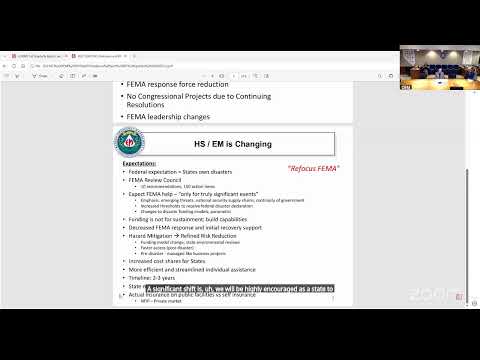
Thompson told the commission the shutdown caused 118 days in which state partners had limited engagement with FEMA, which shut down online training, grant-reimbursement systems and other services. He said the disruption delayed reimbursements to subgrantees, slowed training, and compressed timelines for grant approvals; Nevada is still awaiting release of some Homeland Security grant investment justifications and the state experienced compressed approval timelines in 2025.
The FEMA review council report, Thompson said, emphasizes that "states and locals will own disasters" and that FEMA will be refocused on only the most significant events. The recommendations include higher thresholds for federal disaster declarations, a possible "deductible" model where states pay a portion of initial response costs, a shift toward parametric funding for quicker reimbursements, delegation of certain environmental reviews to states (with state costs), and an increased state cost share for hazard-mitigation-type programs.
Thompson also noted effects on FEMA workforce capacity, a short-term increase in congressionally designated projects for Nevada amounting to roughly $3.28 million, and recent changes in acting FEMA leadership. He told commissioners the state should plan for greater self-sufficiency, pre-vetted "shovel-ready" mitigation projects, and a larger emphasis on public-private partnerships and insurance for public facilities.
Commission members asked whether missing guidance put programs at risk; Thompson said many jurisdictions had already spent or committed funds and that specific categories (e.g., border support construction) cannot proceed until FEMA releases investment justification documents. No formal commission action was taken on the briefing.