Get Full Government Meeting Transcripts, Videos, & Alerts Forever!
Get email alerts on the Zoning Economic Growth District topic
No spam. Unsubscribe anytime.
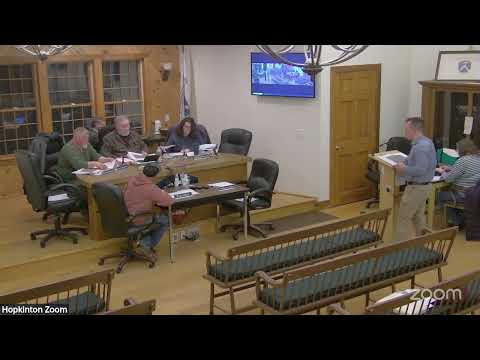
Planning board tables proposed Economic Growth District after residents raise safety and environmental questions
Summary
Hopkinton Planning Board tabled a zoning ordinance amendment that would create an Economic Growth District for properties tied to the applicant, citing outstanding details on allowed uses, hazardous-materials controls, buffers to waterways and remaining map/wetlands work.
The Hopkinton Planning Board on March 4 voted to table a proposed zoning ordinance amendment to create an Economic Growth District for properties proposed by the applicant (identified in filings as Revity/Revy Energy). The board and residents pressed the applicant for clearer limits on industrial uses, hazardous-materials controls and maps showing buffers to nearby water resources.
Attorney Joel Roacher, representing the applicant, described the amendment as a tool to allow a broader set of commercial and light-industrial uses that would align the zoning with the town’s comprehensive plan. "We want this to be collaborative," said Ryan, the applicant representative, who also told the board: "We have no planned tenants, no specific uses. The overall goal is to attract unburdened tax revenue to the town … by the time a project like this gets developed, we're probably looking three to five years out."
Residents and board members asked for more precise language on hazardous materials and decommissioning and for clearer wetlands and buffer mapping. Resident Jean Shields told the board she remained concerned that wording such as “modify,” “new,” “increase” and “revise” implied substantive changes to a previously approved project; she cited large panel-area figures and trucking/erosion concerns as reasons to require more detail before a zoning change.
The board’s solicitor and staff said they have been working with the applicant and recommended tabling the matter so staff, the applicant and the council (for the associated comprehensive-plan amendment) can refine language and maps. A motion to table passed on a recorded voice vote; the board set follow-up meetings including a March 24 special session and the regular April 1 meeting for continued review.
Next steps: the applicant will supply more detailed maps and draft use/design standards for review; the board said it will expect wetlands delineations, clearer hazardous-materials provisions and specific buffer distances before taking a recommendation on the ordinance.