Get Full Government Meeting Transcripts, Videos, & Alerts Forever!
Get email alerts on the Legislation topic
No spam. Unsubscribe anytime.
District warns special-education funding shortfall and flags broad new cell-phone law
Summary
Legislative liaison Shannon told the board that conference committee negotiations appear to restore $6 million in new special-education funding (below House proposals), raised concerns that would leave districts paying a larger share of excess costs, and described a broadly worded cell-phone law signed by the governor that will require local policy changes; HB 2320 adds a two-business-day deadline for sending foster-student records.
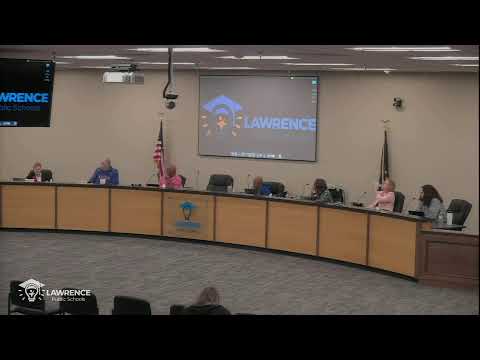
At the March 23 meeting, the district's legislative liaison, Shannon, briefed the board on late-stage state budget negotiations and several bills that could affect local operations.
Shannon said conference committee positions she observed left $6 million in new special-education funding for the coming year — a compromise between the House and Senate proposals — and warned that, if unchanged, the result would lower the state share of special-education excess cost to an estimated roughly 65% for the 2026–27 school year. She cited the statute discussed in the presentation, K.S.A. 72-5192, which directs the legislature to give priority to appropriations supporting state aid and special-education services. The superintendent and other speakers described the trend as insufficient to meet historic obligations.
"With six million new dollars in special ed funding, I believe that we will drop to somewhere around 65% of excess cost funded for the upcoming school year in 26-27," Shannon said. The district framed the funding level as a continuation of a long-running funding shortfall and cited prior litigation tied to the Montoy case and the Kansas School Equity and Enhancement Act.
Shannon also summarized a recently signed state law that broadly restricts student possession and use of personal electronic devices from the start to the end of the school day, and includes provisions that limit district use of social media for two-way communications and shifts some accreditation authority for nonpublic schools. District staff said the statute's language is broad and implementation questions remain (for example, whether devices may be left in backpacks or must be physically secured), and they signaled forthcoming policy changes.
Shannon noted several other items of interest: a bill (HB 2320) that would require districts to send enrollment and special-education records for students who undergo a foster-placement change within two business days of receiving notice, and discussion about virtual-school proctoring and dual-enrollment compensation that may affect district programs. She reported the voucher bill had passed both houses and was on its way to the governor.
Board members asked clarifying questions about the foster-records time frame, implementation challenges for the cell-phone law and the status of mental-health intervention funding in conference committee. Shannon said some amounts remained unresolved and that conference committee negotiations could change day-to-day.