Get Full Government Meeting Transcripts, Videos, & Alerts Forever!
Get email alerts on the Fund Accounting topic
No spam. Unsubscribe anytime.
Trainer tells Nevada charter finance staff to present budgets by fund; warns mis‑coding can hide deficit spending
Summary
A recorded SPCSA/NDE webinar guided charter school finance staff through governmental fund accounting, legal requirements under NRS/NAC and GASB, common reporting mistakes (mis‑coding, treating appropriations as grants) and next steps, including follow‑up PCFP mechanics training.
A recorded training for Nevada charter school finance staff emphasized that school boards must review and authorize budgets on a fund basis and warned that common bookkeeping practices can mask deficit spending and reduce future funding. The presenter, a session facilitator later identified in chat as Dusty, framed the session as practical guidance prompted by repeated questions from schools about budgets, quarterly financials and 387/388A reporting.
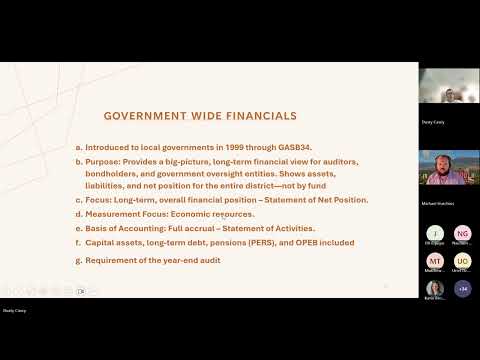
The session explained the difference between fund financials (used for budgets and quarterly reporting) and governmentwide financials (prepared by auditors under GASB standards). “Your boards have to authorize your resources,” the presenter said, stressing that board approval must show inflows and outflows at the fund level so school leaders remain within legally authorized spending limits. He added that auditors still prepare governmentwide statements at year end to report long‑term assets, pensions and depreciation.
Trainer guidance focused on the Nevada Department of Education chart of accounts, common coding conventions (fiscal fund, project/grant, program/function/object) and the legal basis for fund reporting in Nevada law (NRS) and administrative rules (NAC). The presenter gave examples of three GASB fund categories—governmental (most charter funds), proprietary (enterprise activities such as a significant school store) and fiduciary (student club funds)—and recommended tracking substantial federal/state grants in separate fiscal funds when warranted.
A central theme was the difference between legislative appropriations (for example, ELL, at‑risk and state special education) and grants. The trainer warned that some schools code appropriations as if they were grants, matching revenues to expenditures dollar for dollar; that practice can hide transfers from the general fund and understate deficit spending in special programs. He illustrated this with a sample four‑fund worksheet in which state special education showed $100,000 in state revenue and $300,000 in expenditures, requiring a $200,000 transfer from the general fund to zero out the special education fund.
The webinar also covered practical questions about budget amendments, timing and reporting. Presenter guidance included: districts typically amend budgets after the October 1 enrollment count; charters may amend at different points but should submit amendments before spending thresholds are reached; and auditors will continue to produce governmentwide financials (GASB 34) at audit but quarterly reporting will move toward fund‑basis templates.
On debt and lease accounting the trainer explained that fund financials record the cash payments (principal and interest) as expenditures, while depreciation and long‑term liabilities are captured in governmentwide audit schedules under GASB rules. He advised coding multi‑year leases and long‑term debt to debt service object codes (800s) and treating short‑term annual rentals as operating lease expense when the agreement renews annually.
Attendees asked detailed questions about specific coding (e.g., where to place split positions paid partly with Title I funds), worksheet balances on the 387/388A reports and whether leftover restricted funds must be returned. The presenter recommended documenting ending fund balances on the worksheet so total resources equal total applications; he noted that an unexplained positive balance in a restricted fund will be flagged by NDE and typically requires reconciliation or reallocation.
The session closed with an offer of follow‑up trainings (PCFP mechanics, chart‑of‑accounts coding best practices, year‑end audit prep) and a pledge to post sample chart‑of‑accounts templates and resources alongside the recorded webinar. The presenter encouraged schools to reach out for help before board approval because the board’s fund‑level authorization legally limits school spending going into the fiscal year.