Get Full Government Meeting Transcripts, Videos, & Alerts Forever!
Get email alerts on the Transportation Utility Fee topic
No spam. Unsubscribe anytime.
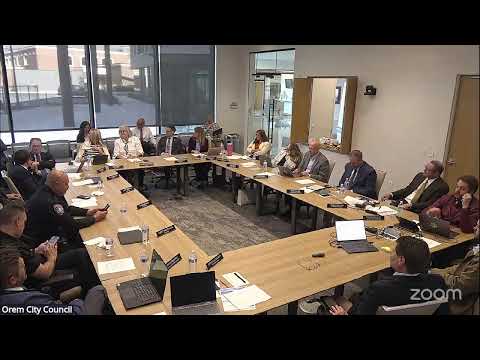
Council hears transportation utility fee study that could raise millions for Orem streets
Summary
Staff presented a transportation utility fee (TUF) study and said a $4 million TUF could close an identified $4M annual maintenance gap in the city's pavement program; the proposal uses trip-generation methodology and would differentiate residential and commercial rates under House Bill 425.
City staff presented a transportation utility fee (TUF) study and legal background to the council, explaining how the new Utah authorization (House Bill 425) allows municipalities to impose a fee tied to trip generation and the cost of maintaining local streets.
Chris, presenting the TUF analysis, said the study used weekday trip-generation rates (the Institute of Transportation Engineers methodology) to establish a nexus between users and costs. The study found a maintenance and funding gap for the city's pavement-management program of roughly $4 million annually to support preventive maintenance and avoid widespread, expensive roadway reconstructions.
Using the methodology presented, staff estimated the per-parcel impact of several scenarios. A $1 million revenue scenario would produce roughly $0.90 per month for an average residential parcel and about $0.31 per month on average for non-residential parcels; staff scaled those values to illustrate how a $4 million TUF would increase the monthly amounts proportionally. Staff emphasized these are study-based estimates and that the final rate schedule and classifications would be refined with additional data collection (including detailed campus studies at large generators like Utah Valley University).
Chris reviewed key legal and procedural points from the 2026 legislation: the fee must show a reasonable relationship between the fee and the benefit, the city must conduct a study that demonstrates a maintenance need and funding gap, the fee must provide differentiated rates for user classes (residential vs. commercial), the city must hold a public hearing before adopting a TUF ordinance, and the fee sunsets after ten years unless renewed.
Staff also compared Orem's potential TUF outcomes with other Utah cities and noted substantial variability in how other jurisdictions designed or implemented fees. They recommended careful outreach and a phased public-hearing schedule if the council wishes to move forward; staff described the TUF as a tool to fund long-term preventive maintenance and to reduce the risk of future large-scale reconstructions.
The council did not take a vote on a TUF at the session. Staff said they would continue detailed data collection (including additional counts and campus evaluations) and return with a draft ordinance and public-engagement plan if the council directs.