Get Full Government Meeting Transcripts, Videos, & Alerts Forever!
Get email alerts on the Public Records topic
No spam. Unsubscribe anytime.
Interim committee advances public‑records bill and considers beefing up ombudsman office
Summary
A joint interim committee in Lander advanced a draft bill (Senate File 49) that would shorten acknowledgement and production deadlines, adopt a state fee schedule, expand ombudsman authority to grant extensions, and raise civil penalties; lawmakers asked a working group to refine a two‑track approach distinguishing commercial data miners from public‑interest requesters and to draft a companion bill that would strengthen and appropriately staff the ombudsman.
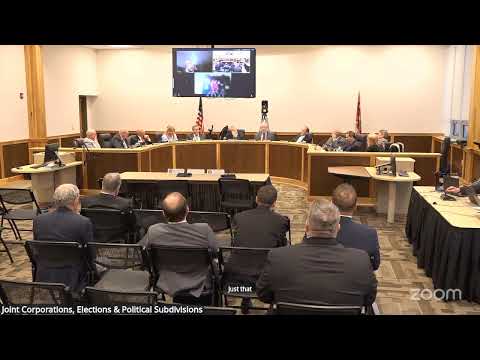
The Joint Interim Corporations Committee voted May 21 in Lander to advance a draft public‑records bill and asked staff and a working group to refine its timetable, fee and enforcement provisions while preparing a separate proposal to strengthen the state ombudsman’s office.
The bill presented by Josh Anderson of the Legislative Service Office would require governmental entities to acknowledge records requests within three business days and to release readily available documents immediately, with a proposed 10‑day production deadline for other records. It would also require most non‑state agencies to use the state fee schedule unless they charge lower rates or receive ombudsman approval to charge more, and would raise the maximum civil penalty for violations from $750 to $2,000. The draft gives the ombudsman authority to grant limited extensions and to refer matters to prosecutors or courts.
Committee members and dozens of witnesses — including the state ombudsman, local clerks, municipal and county associations, the Wyoming Press Association and national policy groups — packed the meeting and urged refinements. Darlene Potter, the state ombudsman, said her office is overloaded and urged caution before imposing strict deadlines statewide. “I’m up to 49 cases currently for one person,” Potter said, describing a heavy caseload and the need for additional staff and legal support.
Reporters, press groups and the Goldwater Institute supported a two‑track approach that treats commercial data miners differently from journalists, nonprofit researchers and ordinary citizens. Parker Jackson of the Goldwater Institute urged the committee to consider Arizona’s commercial‑purpose statute (ARS 39‑121.03), which allows governments to recover the cost of search, redaction and production from requesters who seek records for resale or other commercial exploitation. “Commercial purpose” language in that statute focuses on direct economic exploitation of public records while protecting ordinary news gathering, Jackson said.
Local clerks and special‑district representatives warned that many small entities run on volunteer time and lack the staff to meet compressed deadlines. Amanda Hutchinson, a county clerk who handles requests regularly, said one recent search returned 63,000 emails and argued strict 10‑day timelines would be impractical during election cycles. “If it becomes a 10‑day response time in my county,” she said, “I probably have to tell my commissioners I can’t do it anymore.”
Other witnesses stressed tradeoffs: the State Auditor’s office and the University of Wyoming encouraged publishing routine data online to reduce ad hoc requests, while credit‑union and industry witnesses warned that some records (property encumbrances, personal financial details) can enable fraud if broadly exposed. The Auditor’s office described the WyOpen initiative — a public state checkbook portal launched in 2019 and later codified by statute — as a model of how proactive publication can reduce demand.
On the bill’s next steps, the committee voted to advance the draft and asked a working group to prepare specific options: a two‑track request classification (expedited for in‑state, public‑interest requests and a separate, fee‑based track for commercial requests), calibrated timelines, statutory authority for the ombudsman to waive fees in extraordinary cases, and an attorney‑fee mechanism to deter abusive filings. Lawmakers also directed staff to draft a separate companion bill to strengthen the ombudsman itself — potentially adding a full‑time staffer (a deputy for open meetings), a half‑time attorney, a multi‑member hiring panel and a fixed multi‑year appointment term — so the ombudsman can provide timely mediation and, where appropriate, binding remedies.
Chairman Casease said the goal is to balance timely public access with workable rules for small governments. LSO staff indicated the working group will return refinements to the committee at a later meeting; the committee did not adopt final statutory text at the May 21 session.
What’s next: the working group will refine definitions and timelines and draft the companion ombudsman staffing/authority bill for committee consideration; committee members said they want clear, enforceable language that protects privacy, prevents fee abuse by commercial requesters and gives the ombudsman the staff and legal tools to mediate disputes without pushing every case into court.