Get Full Government Meeting Transcripts, Videos, & Alerts Forever!
Get email alerts on the Emerald Ash Borer Todd County topic
No spam. Unsubscribe anytime.
Minnesota Department of Agriculture announces emerald ash borer find in Todd County; details quarantine, ID and response steps
Summary
The Minnesota Department of Agriculture confirmed an emerald ash borer detection in Todd County and outlined an emergency quarantine restricting movement of ash material and hardwood firewood; the agency reviewed identification signs, management options and how residents and businesses should report suspected infestations.
John, Emerald Ash Borer Technical Assistance Coordinator at the Minnesota Department of Agriculture, announced a confirmed emerald ash borer (EAB) detection in southeastern Todd County and described emergency quarantine measures and guidance for residents and businesses.
“We're having this meeting due to the recent find of emerald ash borer in Todd County,” John said, noting the detection is near county borders and that the discovery prompted the emergency quarantine now in a 45‑day comment period.
The agency said the state maintains an EAB status map that it updates nightly and that 60 of Minnesota's 87 counties now have known infestations. The emergency designation for Todd County restricts movement of regulated articles — defined by the department as any ash material, any life stage of emerald ash borer, mulch and all hardwood firewood cut to less than 4 feet in length — out of the quarantined area unless moved under a compliance agreement.
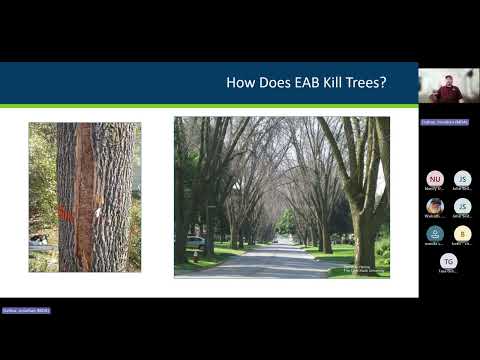
John described how EAB reproduces and kills ash trees: females lay roughly 60–90 eggs in mid‑to‑upper canopy branches, larvae tunnel under the bark creating distinctive S‑shaped galleries and, over several years, populations can build to levels that girdle and kill mature ash. He said native Minnesota ash species (green, black and white ash) are highly susceptible and that local mortality for infected trees is approximately 99 percent.
On identifying EAB, the MDA official emphasized four confirmation methods: finding the S‑shaped larval galleries under bark, finding a larva with two tail spines (urigampi), observing the iridescent green adult beetle (rarely seen) or locating the small D‑shaped exit holes adults leave. He also urged residents to watch for 'blonding' from woodpecker foraging and small, shallow woodpecker holes in mid‑canopy branches as early signs.
The department reviewed recommended management options. For homeowners and communities, choices include staged removals of poor‑condition trees or insecticide treatments for high‑value trees. John advised considering treatment when a property is within about 10 miles of a known infestation: “When you're within 10 miles of a known infested area, that's when you want to start considering treatments,” he said. He noted homeowner treatment costs are roughly $12 per diameter inch (approximate) and that professional injections of emamectin benzoate are commonly used and generally provide two years of protection.
The MDA detailed compliance and processing options for regulated wood: chipping or grinding to specified mulch particle sizes, debarking plus removal of 1/2 inch of sapwood, composting to required temperatures and time, and a heat‑treatment certification program for firewood dealers (kiln at 140°F held for 60 minutes). John said there are currently 15 certified firewood producers in the state whose product may move freely statewide, and he reiterated the 'buy where you burn it' message to avoid long‑distance movement of untreated firewood.
The department also pointed to resources for larger forested properties: the DNR Forest Stewardship Program can provide cost‑share and technical assistance for woodland owners, and the DNR Urban and Community Forestry Program offers community forestry grants (typically available in fall) that may fund inventories, removals and replanting. John recommended professional treatment for trees over 15 inches in diameter at breast height and advised that trees with roughly 70 percent or more healthy canopy are the best candidates for treatment.
For reporting suspected EAB, John asked residents to take clear photos, provide specific locations and use MDA's 'report a pest' online form, email or voicemail, or the EDDMaps app. He said reports help refine the statewide map and guide follow‑up inspections. Attendees were told the session was recorded and would be posted on the MDA YouTube channel within a few days.
At the end of the presentation, a participant identified as Nancy asked whether MDA would contact wood businesses in Todd County; John replied he does not have a preexisting list but offered to follow up if attendees provide names so he can reach out about the new movement rules.
The department encouraged questions and provided contact information for follow‑up.