Get Full Government Meeting Transcripts, Videos, & Alerts Forever!
Get email alerts on the Professional Regulation topic
No spam. Unsubscribe anytime.
Texas Board of Chiropractic Examiners directs delegate to cast a 'no' on NBCE/FCLB merger after legal, timing and disclosure concerns
Summary
At a special April 16 meeting, the Texas Board of Chiropractic Examiners heard public comment alleging statutory conflicts and incomplete financial disclosure related to a proposed NBCE/FCLB merger, debated legal authority and timing, and voted 7–0 with 1 abstention to instruct its Atlanta delegate to cast a "no" vote.
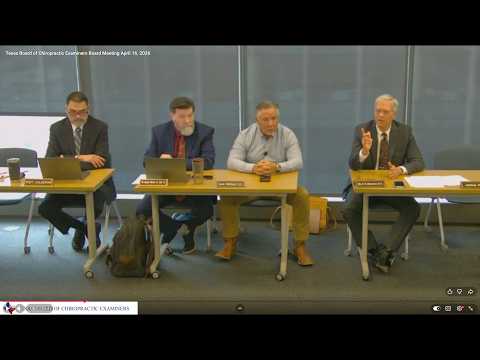
At a special called meeting on April 16, the Texas Board of Chiropractic Examiners discussed whether to instruct its delegate to vote on a proposed merger between the National Board of Chiropractic Examiners (NBCE) and the Federation of Chiropractic Licensing Boards (FCLB) and ultimately empowered the delegate to cast a collective "no." The meeting began at about 9:08 a.m.; eight of nine board members were present, establishing a quorum.
During the public-comment period, Dr. Steve Tullius, representing the Chiropractic Society of Texas and the Chiropractic Freedom Coalition, urged the board to seek a formal legal opinion and full financial disclosure before participating in the merger vote. "Board members cannot by law participate in the operational management of the very entity that the state relies upon for testing and licensing services," Tullius said, and asked whether the board had reviewed financial records for the NBCE, FCLB, Ethics and Boundaries Assessment Services (EBAS), and an entity identified as MPOC.
Board members spent the meeting weighing three core concerns: (1) whether the board has statutory authority to participate in the corporate restructuring of two private nonprofits; (2) whether the proposed post-merger structure would create prohibited operational or financial ties between board officers and a vendor the board relies on for licensure testing; and (3) whether the board had been given sufficient information and time to evaluate the change. Several members, including Dr. Matthew Mix and Dr. Nicholas Balkcom, said they felt the board had been provided only a short window (the board learned of the plan in October and had roughly four to five months to consider it) and sought written legal guidance before formally endorsing participation.
Staff and counsel described the merger plan as FCLB being folded into NBCE, with the FCLB becoming a standing committee inside NBCE and member boards moving from dues-based membership to a voluntary subscription model for specific services. Executive staff said certain services the board values — including EBAS and the CINBAD background-reporting service — would remain available in some form though governance and access could change. General counsel Rudy Calderon cautioned that while the board, as a member of FCLB, has the authority to vote at the national meeting, the consequences of a merger — and how the board and its officers would interact with a consolidated NBCE — may implicate statutes that bar officers or employees from participating in businesses where the state or agency contracts.
Board members debated options including a formal "no" vote, abstention, or directing the delegate to act otherwise. Dr. Michael Henry indicated he might move to abstain given unresolved legal questions, while others said a recorded "no" could more strongly signal statutory concerns to other state boards. After discussion, Mr. Joshua Hollub moved that the board "cast . . . a no vote" at the national meeting on behalf of the board; Dr. Michael Henry seconded. The chair recorded seven board members in favor and one abstention; the motion carried, and the chair said he would exercise the delegated vote consistent with the board's instruction.
Board counsel and staff said the matter of how the board would interact with any merged NBCE going forward would require follow-up review and possibly an attorney general opinion to clarify the limits of participation and procurement/arms‑length concerns under Texas law. The board also recorded a future agenda request to review rules for the Part Four board exam and alternative testing options at the next regular meeting.
The meeting concluded with the motion carried and adjournment. The board did not vote to join a merged governance structure; rather it instructed its delegate how to vote at the NBCE/FCLB meeting. The board noted unresolved legal questions and the need for further staff and counsel work after the national vote.