Get Full Government Meeting Transcripts, Videos, & Alerts Forever!
Get email alerts on the Academic Programs topic
No spam. Unsubscribe anytime.
TSU committee recommends full-board approval of academic concentrations including MBA 4+1 and data-science tracks
Summary
The Tennessee State University Student and Academic Affairs Committee on May 13 recommended the Board of Trustees approve a set of academic concentrations — including an MBA 4+1 pathway and computer-science/data-science concentrations — noting they require only notification to the Tennessee Higher Education Commission and add no new faculty or cost; a trustee asked staff to provide follow-up on financial-aid impacts for Pell-eligible students.
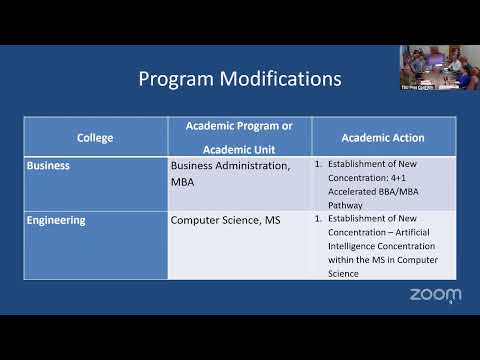
The Tennessee State University Student and Academic Affairs Committee on May 13 voted to recommend that the full Board of Trustees approve a package of academic concentrations, including an MBA 4+1 pathway and new computer-science and data-science concentrations.
Provost Smeller told trustees the items before the committee are concentrations rather than new degree programs and ‘‘there’s no additional new faculty’’ or added cost because the courses are already in the inventory. He described the MBA 4+1 as ‘‘a way to really kind of benefit our undergraduate students, the high-performing undergraduate students, to give them this really great opportunity to get some graduate courses under their belt, four of them with the hope that their taste for it leads them to complete the MBA with TSU.’’
Smeller distinguished the Master of Science in Computer Science — ‘‘the more focused degree in the sense that a bachelor’s degree in computer science is really necessary to pursue this degree’’ — from broader data-science concentrations that are ‘‘more broadly open to folks from any major.’’ He also noted that, if approved by the board, the changes would require notification to the Tennessee Higher Education Commission (THECC) and would not trigger notification to the Southern Association of Colleges and Schools Commission on Colleges (SACSCOC) because these are program-level concentrations rather than new degrees.
Trustee Northlee raised a concern about student persistence and completion among the university’s largely Pell-eligible population, asking whether the proposal had considered ‘‘fifth-year attrition in terms of the students being able to pay as they switch from the undergraduate financial aid to the graduate aid?’’ Provost Smeller said that specific issue ‘‘was not addressed in the proposal’’ and offered to ‘‘dig back in and get you additional information on that.’’
With no further substantive questions, a motion to recommend the proposed academic programs and academic units to the full board was moved and seconded. Secretary Brown conducted a roll-call vote; the transcript records ‘‘Yes’’ votes from Trustees Northway, Smith and Whitten and records that the motion carried. The committee then moved and approved an adjournment.
Next steps: the recommendation will go to the full Board of Trustees for consideration; committee members asked staff to provide additional detail on financial-aid and persistence implications for students who might participate in the 4+1 pathway.