Get Full Government Meeting Transcripts, Videos, & Alerts Forever!
Get email alerts on the Food Safety topic
No spam. Unsubscribe anytime.
KDA training tells mobile vendors: keep cold at 41°F or below, hot at 135°F or above
Summary
Kansas Department of Agriculture inspectors and county staff told mobile food vendors at a Douglas County training that strict temperature controls, accessible handwashing, proper gray-water disposal, and date-marking are core requirements; imminent hazards (no water, refrigeration loss) can prompt voluntary closure.
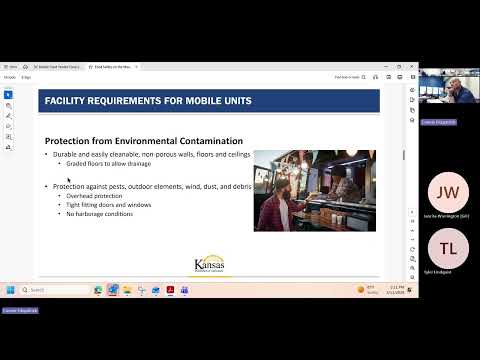
Kansas Department of Agriculture presenters told mobile food vendors at a Douglas County Food Policy Council training that strict temperature control, sanitation and hygiene practices are critical to prevent foodborne illness ahead of a projected influx of World Cup visitors.
"Cold foods need to be kept 41 or below and hot foods need to be 135 or above," said the KDA presenter identified in the session as Paulie, summarizing core holding-temperature rules. The presenters advised vendors to use stem or digital thermometers and to take food temperatures every two to three hours during service.
The training explained other specific operational requirements. Mobile units must have at least one accessible handwashing sink with hot and cold water, soap, paper towels and a trash receptacle; water supplies must be from an approved portable source and hoses and tanks must be food-grade and flushed regularly after storage. Presenters said gray-water tanks should be at least 15% larger than fresh-water tanks and that wastewater must be discarded at approved dump sites rather than onto the ground.
KDA staff outlined six food-safety risk factors they inspect for: food source, inadequate cooking, improper holding temperatures, contamination, poor personal hygiene, and environmental contamination. On cooling, vendors were told to follow a two-stage process: cool from 135°F to 70°F within two hours and to 41°F within six hours. Reheated foods must reach an internal temperature of 165°F within two hours and be held at 135°F or higher thereafter.
Presenters emphasized handwashing as the primary control and said gloves do not replace handwashing. "Single-use gloves do not replace the need for good handwashing practices," Paulie said, urging operators to adopt employee-illness policies that keep staff with vomiting or diarrhea off the line. Cross-contamination controls—storing ready-to-eat foods above raw items and labeling and separating chemicals—were also covered.
The presenters warned that certain conditions constitute an "imminent health hazard" under the Kansas Food Code—examples cited included lack of water, sewage backup, lack of refrigeration, pest infestation, and ill food employees—and that inspectors may request voluntary closure until hazards are corrected.
Vendors asked where to legally dispose of gray water; presenters said options vary by location (fairgrounds, campgrounds, cooperating restaurants) and advised contacting local jurisdiction staff to identify approved dump sites. The session ended with organizers saying they will post the training recording and a packet of resources on the Food Policy Council website.
Next steps: vendors seeking licensure or inspection were advised to start the application process with the Department of Agriculture; operators running more than six days must obtain a food-establishment license, and all vendors must follow Kansas Food Code requirements whether licensed or not.