Get Full Government Meeting Transcripts, Videos, & Alerts Forever!
Get email alerts on the Prevention Healthcare Reform topic
No spam. Unsubscribe anytime.
Ways and Means subcommittee hears push to steer U.S. health care toward prevention
Summary
A House Ways and Means subcommittee field hearing in Florida spotlighted prevention-focused medical training, expanded screening and payment changes to shift care upstream. Witnesses and members emphasized nutrition training, rural rotations, lung cancer screening expansion and the need to align insurance reimbursements with preventive services.
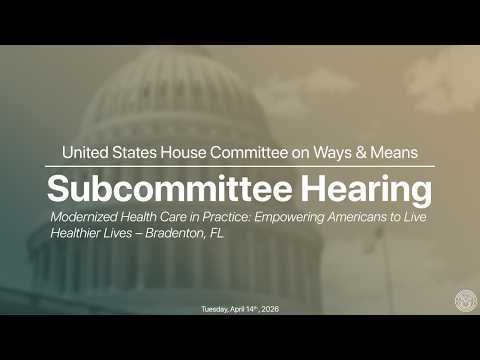
Chairman Smith, chair of the House Ways and Means Committee, opened a field hearing in Southwest Florida by urging a shift in federal incentives "to provide preventive care, not just treatment," and stressed that Medicare currently spends little on primary care.
"Too often we intervene only once someone has gotten sick," Chairman Smith said in his opening remarks, calling for value-based payments and expanded screening for older Americans. He cited several committee priorities including enhanced nutrition training for medical students, multi-cancer early detection pilots for Medicare beneficiaries and programs aimed at rural health transformation.
The panel of witnesses — clinicians, a medical school dean and an advocacy director — described concrete approaches and barriers to making prevention widely available. Dr. Christopher Davis, an interventional cardiologist who founded the Reveal Vitality and Longevity Institute, said he changed his practice to focus on upstream care, including genetic, micronutrient and environmental toxin testing, because "we must stop waiting for disease and start identifying risk before it becomes irreversible." He added that many of those tests and services currently lack insurance coverage and are out of reach for underserved patients.
Dr. Kaufman, dean of the Lake Erie College of Osteopathic Medicine in Bradenton, described curricular changes that embed nutrition and prevention into case-based learning and highlighted the role of rural clinical rotations in producing physicians who remain in underserved areas. "By lowering financial barriers," he said, his institution has increased the share of graduates entering primary care.
Dr. Reckase, a bariatric surgeon, urged Congress to treat obesity "as a chronic disease," to expand access to evidence-based treatments including bariatric surgery and newer GLP-1–class medications, and to reimburse earlier screening and nutrition counseling. "We have the treatments; access, not science, is now the limiting factor," he said.
Patrick Woo, CEO of Moffitt Cancer Center, pressed for wider use of lung cancer screening and fewer administrative hurdles. He said mobile CT screening could reach smokers in church parking lots and other community sites but is often constrained by preauthorization requirements. "If we can get rid of the preauthorization for lung cancer screening, it would be a lot easier to go," he said, adding that wider screening could prevent many deaths.
Scott Darius, executive director of Florida Voices for Health, brought local context: rising premiums in Florida's Affordable Care Act marketplace, rural hospital closures and dental shortage areas. He warned that coverage gaps and steep premium increases push people into a coverage gap in which modest earnings loss or gain can mean losing Medicaid without qualifying for marketplace subsidies.
Throughout a prolonged question-and-answer period, members pressed witnesses on policy levers: expanding graduate medical education slots and rural rotations, loan forgiveness and tax incentives to steer graduates into primary care, streamlined prior authorization, broader Medicare coverage for preventive tests and greater use of telehealth and digital pathology to support rural providers.
Committee members and witnesses repeatedly returned to financing: several members argued that federal reimbursement should reward outcomes — fewer hospitalizations and complications — rather than high-cost procedures. Witnesses recommended piloting alternative payment models that reimburse for screening, nutrition counseling and community-based prevention programs, and using digital tools to extend specialist expertise into underserved communities.
The hearing produced no votes; members reserved further questions for the record. Lawmakers said written materials and witness recommendations will inform follow-up work on financing, workforce training and regulatory barriers to prevention.