Get Full Government Meeting Transcripts, Videos, & Alerts Forever!
Get email alerts on the Board Business topic
No spam. Unsubscribe anytime.
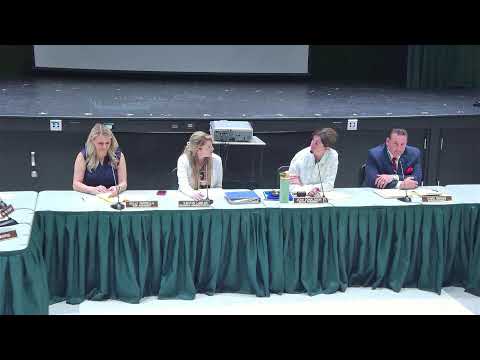
Kinnelon board discusses nonresident tuition, cell-phone lockers and steep health‑care increases; approves minutes and block vote
Summary
At its May 19 meeting the Kinnelon Board reviewed a draft nonresident tuition policy (implementation planned Sept. 2026), debated use of a $7,000 cell-phone-free grant to buy phone lockers, and discussed projected health insurance premium increases that the board said have driven budget pressure; the board approved minutes and a block roll-call vote on agenda items A–D.
The Kinnelon Board of Education spent the May 19 meeting weighing several operational items with possible budget implications: a nonresident tuition policy and rate schedule the board will vote on, a $7,000 cell-phone-free grant proposed to fund phone lockers, and large projected increases in health insurance premiums that administrators say are straining district finances.
Superintendent (S7) told the board the nonresident tuition policy and associated rates (separate rates for K–5, 6–8 and 9–12) are on the agenda and, if approved by a majority, would go into effect for students applying in the 2026–27 school year. “The board has to vote. Once it goes public, assuming that it passes in the majority, this will be live,” S7 said.
Finance committee chair (S5) reported on facilities and contracts and flagged a $7,000 cell-phone-free school grant the administration received. “We were able to get a cell phone free school grant, and they gave us $7,000,” S5 said; the committee recommended using the money to purchase phone lockers to be rolled out at KHS over the summer. Board members debated whether providing lockers in classrooms would be consistent with the district’s current policy prohibiting phones in classrooms or would require a policy change.
The board also discussed projected health-care premium increases. S2 noted a resolution that references a 31.9% premium increase that took effect in January 2026 and described “an overall premium increase of nearly 74% in the preceding five years.” Administration (S3) clarified district-level impacts, saying the district experienced a smaller increase than the statewide average and had budgeted a contingency: “31 percent was the average through the state. We went up 16 and a half, but we budgeted 19 as a contingency,” S3 said.
Committee reports included planned summer capital projects with common June 15 start dates (cafeteria demolition and art-room relocation) and longer-timeline upgrades (auditorium lighting and electrical targeted for October). The finance report also listed emergency boiler work, HVAC repairs, and contract renewals the administration expects to address ahead of the next school year.
The board approved the April 28, 2026 minutes after a motion and second and later approved a roll-call block vote for agenda items A–D. Roll-call tallies called each seat in succession and recorded affirmative votes; the clerk (Kayla) executed the official roll call.
Before adjourning to an executive session to discuss legal and student matters (no action expected), the board scheduled additional public review of the parental bill of rights and the nonresident tuition item for the June 9 agenda.