Get Full Government Meeting Transcripts, Videos, & Alerts Forever!
Get email alerts on the Rezoning RZ016261 2025 topic
No spam. Unsubscribe anytime.
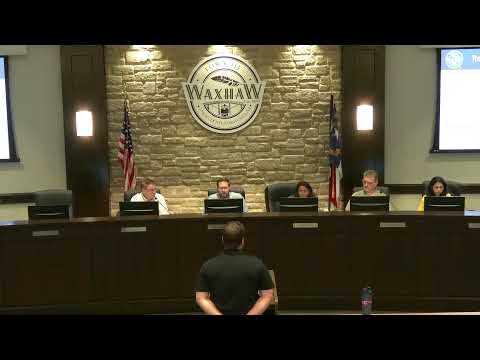
Planning board recommends against rezoning of former Grace Presbyterian at 5017 Waxhaw Marvin Road
Summary
The Waxhaw Planning Board voted unanimously to give an unfavorable recommendation for rezoning petition RZ016261-2025, which sought Neighborhood Center zoning for three parcels at 5017 Waxhaw Marvin Road to allow an event center/micro-wedding use; board members cited concern about 87 by-right uses that would accompany a general rezoning and potential future redevelopment impacts.
The Waxhaw Planning Board on July 15 voted unanimously to issue an unfavorable recommendation on rezoning petition RZ016261-2025, a request to change three parcels at 5017 Waxhaw Marvin Road from R-4 single-family residential to Neighborhood Center (NC).
Staff planner Madison, presenting the petition, said the application covers three parcels totaling about 2.05 acres that include the former Grace Presbyterian Church and was filed on behalf of applicant Sharon Dednam. Madison described the requested NC zoning as allowing mixed uses at a neighborhood scale, with nonresidential buildings limited to a 10,000-square-foot footprint, multifamily required above the first floor, and a maximum residential density of 8 units per acre. She also noted two overlay districts affecting the site: the Waxhaw Marvin Corridor overlay, which anticipates right-of-way dedication to accommodate a future three-lane section and Path 13, and a manufactured-home overlay adjacent to mobile-home neighborhoods.
The applicant, identified in staff materials as Sharon Dednam and who spoke during the hearing, said the building is her parents' former church and that she had explored immediate, modest reuse as a micro-wedding event center to prevent the structure from sitting vacant while broader plans are developed. "The intention of creating some space for the community has not changed," the applicant said, describing micro-weddings as an interim use.
Several board members questioned the choice of a general rezoning rather than a site-specific conditional rezoning that could limit allowable uses. Chair (S1) told the applicant, "I like what you're doing," but stressed the board had to consider the full scope of what NC zoning permits. He pointed to the table of uses staff displayed and warned that "there would be 87 different possibilities" that would be allowed by right under a general rezoning. Board members and staff discussed that, in theoretical maximums and absent design constraints, a general rezoning of about 2.05–2.2 acres could allow roughly 16 housing units at 8 units per acre.
Madison and other staff members explained procedural limits on the board's discretion: a general rezoning is evaluated against the Town's adopted land-use map and ordinances, including the Waxhaw 2040 future land use map and the Unified Development Ordinance. Madison also said that while some accessory telecommunications equipment appears as an allowed item in the NC table, a new cell tower would require a separate special use permit; equipment changes to existing facilities can sometimes proceed without additional review.
Board members raised infrastructure and pedestrian concerns tied to future redevelopment. Madison said redevelopment would typically require sidewalk installation (a standard 5-foot sidewalk along the frontage) and that a 50-foot dedication from centerline could be required to accommodate the corridor's planned three-lane section and a 10-foot multiuse path where applicable.
Ultimately, a board member moved for an unfavorable recommendation, stating the rezoning was "inconsistent and unreasonable" with current land-use maps and the 2040 plan. The motion passed unanimously; no votes against or abstentions were recorded. The applicant was advised during the discussion that she could choose to withdraw and pursue a conditional rezoning or other site-specific approvals in the future, though board members and staff emphasized that the planning board itself cannot compel an applicant to withdraw.
The planning board concluded its action on the petition and adjourned the meeting. The unfavorable recommendation recorded is a formal advisory opinion to be included in the town's continuing review of the application.