Get Full Government Meeting Transcripts, Videos, & Alerts Forever!
Get email alerts on the Municipal Budget topic
No spam. Unsubscribe anytime.
Montclair officials warn pensions and health insurance will squeeze next year’s budget
Summary
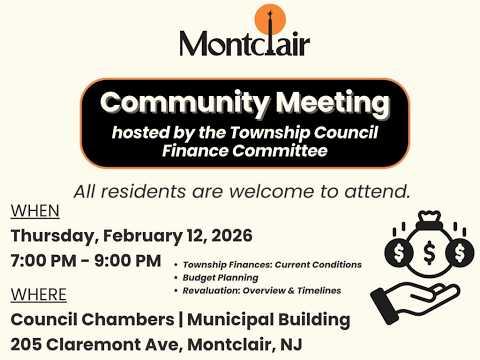
At a Feb. 12 public finance-committee meeting, Councilor Eileen Birmingham and Township Manager Steven Marks laid out fiscal pressures — rising pension obligations and employee health costs — and described measures including a hiring freeze and three budget scenarios ahead of a March 17 budget introduction.
Montclair — Councilor Eileen Birmingham, a member of the township finance committee, and Township Manager Steven Marks told residents at the committee’s Feb. 12 community meeting that rising pension and employee health-care costs are primary drivers squeezing the municipal budget.
Birmingham said Montclair’s 2025 per-household property-tax bill — $22,717 on average in Montclair versus a state average of $10,570 in 2025 — reflects a structural funding challenge: Montclair is heavily residential, receives limited state aid for schools (now less than 10% of the school budget) and therefore relies on property taxes to fund services.
Marks provided a municipal budget snapshot showing roughly 57–58% of each property-tax dollar goes to schools, about 15% to the county and under 25% to the township’s municipal services. He said the town spends about $10 million a year on employee health benefits and that, because the state health benefits plan projected very large increases, the township moved to a fully insured Aetna plan to avoid projected spikes.
“The municipal portion of the tax bill is less than 25%,” Marks said. “If you eliminated the entire municipal government you would only reduce the average tax bill by about $5,000.”
Both speakers highlighted long-term pension burdens. Birmingham cited recent actuarial numbers showing substantial unfunded liabilities in police and public-employee pension plans and noted Montclair must make state-mandated catch-up payments; she said the town is paying an additional $5.3 million a year into the Police and Fire Retirement System (PFRS) to cover unfunded liabilities.
To limit near-term budget shocks, Marks said he directed department heads to prepare three budget scenarios (a wish-list/status-quo, a frozen budget and a 5% reduction plan) and instituted a hiring freeze for nonessential positions. He also reiterated municipal-reserve guidance: the Government Finance Officers Association recommends roughly two months of spending in cash reserves and the town’s surplus position should be managed so one-time fund balance draws are not used as recurring revenue.
On procurement and near-term spending, a resident raised a question about a recent approval of a state-contract vendor, Millennium, to address repeated network outages; Marks said another vendor had a higher quote and that although the contract was approved at a recent council meeting it had not yet been executed.
What’s next: Marks said an unaudited annual financial statement is being prepared and the township anticipates introducing the full 2026 budget on March 17. The committee encouraged residents to check property-tax relief program eligibility and to review budget documents the township will publish online.