Get Full Government Meeting Transcripts, Videos, & Alerts Forever!
Get email alerts on the Land Use Planning topic
No spam. Unsubscribe anytime.
Westville PAC previews major rewrite of municipal planning strategy and land-use bylaw
Summary
Planning staff presented a first-phase consolidation of Westville’s Municipal Planning Strategy and Land Use Bylaw, proposing gentler density, flag/landlocked-lot rules, clearer design standards for mini homes and new tools for vacant lots; PAC asked staff to refine drafts and hold public engagement in January.
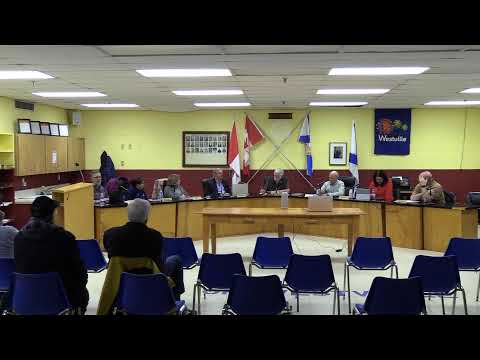
Planning staff delivered a broad first pass at rewriting Westville’s Municipal Planning Strategy (MPS) and Land Use Bylaw (LUB) at the Planning Advisory Committee meeting on Dec. 17, 2025, proposing changes intended to increase infill housing and clarify rules for accessory units, flag and landlocked lots, environmental protections and small-scale renewable energy.
The planner, Sean, told the committee the effort collapses multiple documents into a single Westville MPS and an reorganized LUB, noting the materials still are in phase one of drafting. “We’ve got way over 300 pages of information that we’re trying to churn through and condense down into something manageable,” Sean said, urging the committee to treat the draft as an evolving change matrix rather than a finished product.
Why it matters: The package would shift Westville from numeric zone names toward descriptive ones such as Residential Core, Residential Periphery, Residential Mixed and Land-lease Community; reduce minimum lot frontages and allow a wider range of accessory dwelling units and converted dwellings; and add tools to encourage redevelopment of vacant or dilapidated properties. The intent is to increase the number of homes served by existing infrastructure and slow the town’s growing per-capita cost of roads and services.
Key proposals and committee responses
- Flag and landlocked lots: Sean proposed allowing flag lots and creating landlocked-lot provisions so previously inaccessible parcels can be developed with a minimum 6-metre access strip, registered maintenance agreements and required utility easements. He said such changes would unlock infill without adding municipal road maintenance. Committee members emphasized clear, up-front notice for buyers about private-road responsibilities and maintenance agreements.
- Density and compact housing: To meet housing-accelerator obligations, the draft reduces lot-size and frontage requirements across residential zones and leans on as-of-right options (garden suites, garage suites, basement suites) rather than concentrating compact housing in a single zone. “If we allow people to be creative in how they build their housing, they can live on smaller lots than the ones that have been put in place now,” Sean said.
- Mini homes and manufactured housing: The draft removes restrictive definitions that effectively barred modular construction and renames obsolete terms (for example, changing “mini home park” to “land-lease community”). New façade, skirting and dimensional standards are proposed so replacement units meet modern building and neighbourhood standards; the draft discourages swapping an old mobile home for an equivalent older unit.
- Vacant lots and dilapidated properties: The MPS text includes a policy to study tools aimed at reducing long-term vacancies and derelict houses, from higher vacant-lot tax rates to targeted acquisitions for development. Members noted legal limits under the Municipal Government Act, and staff flagged that tools such as higher tax rates or acquisition pools would need careful design to avoid overreaching.
- Environmental protections and renewable energy: Draft additions call for mapping wetlands and subsidence-prone areas, stronger requirements for grading and stormwater plans in sensitive locations, and an explicit renewable-energy section to permit small-scale solar, geothermal and wind under provincial rules.
Process and next steps
Committee members agreed the draft is substantial but work remains. Several members suggested a small working committee or staff-led working sessions in January to refine policy and bylaw cross-references before broad public engagement. Sean said staff will circulate change matrices and bring updated text back for PAC review, then a targeted public engagement phase will follow.
Quotes from the meeting
- Sean (Planning staff): “We’ve got way over 300 pages of information that we’re trying to churn through and condense down into something manageable.” - Committee member (S2): “Food, crisis that a lot of people in our community are facing right now,” used to argue the draft should better highlight agricultural uses on suitable land. - Committee member (S3) on private-road agreements: “There’s a great confusion there” about who is responsible for maintenance when private roads are assumed to be municipal later.
Formal actions recorded
- Agenda approval: PAC approved the meeting agenda on a motion and voice vote at the start of the meeting (motion moved by Committee member (S3), seconded by Committee member (S4); the recorded voices said “Aye” and the chair declared the motion carried). - Minutes approval: PAC approved the minutes of Nov. 19 on a motion (moved by Committee member (S2), seconded by Committee member (S6)); recorded voices said “Aye” and the chair declared the motion carried. - In-camera motion: A motion to move into camera was put on the floor later in the meeting but members discussed and decided not to proceed; the matter was not taken into a closed session.
What’s unresolved
Staff have not yet finalized the policy references or produced all supporting maps (an environmental features map identifying wetlands and subsidence areas was described as missing). Several procedural and legal clarifications—particularly around vacant-lot taxation tools and precise limits of town authority under the Municipal Government Act—remain to be resolved in subsequent staff work and legal review.
What comes next
PAC asked staff to continue drafting, circulate the change matrix, hold working sessions in early January and prepare materials for a public engagement phase once the draft is more tightly coordinated. The committee will revisit the revised MPS/LUB text before any statutory notices or formal public hearings.
Ending note
Members praised the volume of work completed to date and reiterated that the draft is a starting point: further legal checks, mapping and public input will shape the final MPS and LUB recommendations brought to council.