Get Full Government Meeting Transcripts, Videos, & Alerts Forever!
Get email alerts on the Prudential Committee Duties topic
No spam. Unsubscribe anytime.
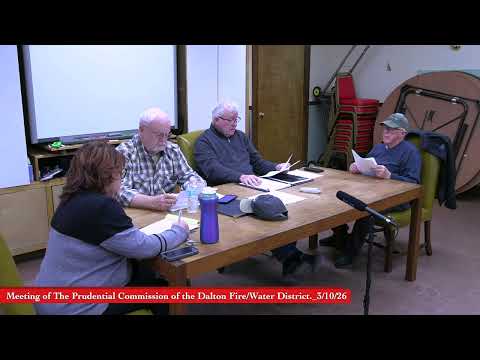
Prudential Committee adopts draft duties and outlines bylaws, training and volunteer steps
Summary
The Prudential Committee voted to adopt a draft of committee duties and discussed next steps including state review of bylaws, written financial policies, job descriptions, SOP legal review, training plans and volunteer recruitment incentives.
The Prudential Committee voted to adopt a draft of the committee’s duties after a brief discussion Tuesday, and members outlined follow-up work on bylaws, job descriptions, standard operating procedures and volunteer recruitment.
The committee’s chair introduced the draft and framed the committee’s role as fiduciary and general manager oversight: “Fiduciary responsibility, ensuring assets are managed wisely and goals are met for the district and its stakeholders,” the chair said, summarizing the document’s intent to review proposals, budgets and contracts and to make recommendations for the annual warrant.
Committee member (speaker 2) moved to accept the draft and the chair seconded; the motion carried by voice vote after the committee heard member feedback that the proposal was “pretty thorough” and a change from a historically advisory role. The motion accepted the “prudential committee draft proposal” as amended in the meeting.
Members said the draft formally records responsibilities that have been informal for decades. The chair traced the committee’s origins to the district charter and said water commissioners remain responsible for day-to-day operations while the Prudential Committee retains oversight. The article summarizes the committee’s agreed duties in the draft: review of proposed budgets and articles for the annual warrant, establishing guidelines and committees to review bylaws and policies, recommending real estate transactions for approval, and participating in contract review alongside water commissioners.
After the vote, members discussed a set of related implementation items the committee plans to pursue: finalizing district bylaws (the committee is awaiting a state review that may require major changes), collecting written financial policies and departmental job descriptions to inform the committee’s guidance, and consolidating SOPs into a controlled digital repository. The chair asked department heads to provide job descriptions and asked staff to prepare written financial policies such as purchase-order practice and capital-budget rules.
Members also agreed to send a small number of unclear SOP sections to the district attorney for legal review before wider implementation, noting the committee will coordinate with water commissioners on attorney engagement due to cost considerations.
Volunteer recruitment and training were prominent topics in the discussion. One member reported volunteer ranks had fallen “from about 38–40 to roughly 12,” with only “about 4 of them [living] in town,” and suggested exploring incentives for local volunteers, such as a water-bill benefit, while maintaining participation and attendance requirements. Dan Santoni, who identified himself as a volunteer living in Adams, described a program from Copake, N.Y., that offered a small tax benefit to volunteers and offered to help locate written policy examples.
Training demands were described as a major barrier to recruitment: one participant said combined Firefighter I/II training can be more than 300 hours over several months (an example cited ran from Feb. 23 through July 1 and included long Saturdays), with limited online options. Members noted FEMA’s training portal was temporarily inaccessible at the time of the meeting, and staff reported the district’s insurance carrier can provide risk-management trainings that generate credits that may be convertible to up to $10,000 at year end.
What happens next: the committee approved the draft duties and directed staff and department heads to provide the requested documents (job descriptions, written financial policies, SOPs) and to coordinate with water commissioners and legal counsel where needed. The committee also asked staff to explore volunteer incentive models and training supports; no further formal votes on those implementation items were recorded at the meeting.