Get Full Government Meeting Transcripts, Videos, & Alerts Forever!
Get email alerts on the Big Project topic
No spam. Unsubscribe anytime.
BNSF says Barstow International Gateway remains active as project awaits EPA decision on CARB waiver
Summary
BNSF told residents the Barstow International Gateway (BIG) remains under development, estimating about 20,000 direct and indirect jobs and an opening around 2028, but said the project’s next steps hinge on an EPA decision about a California Air Resources Board waiver and regulatory uncertainties.
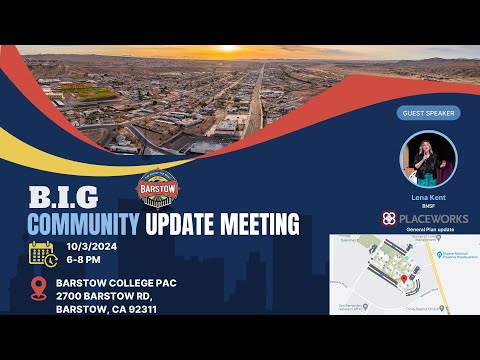
Lena Kent, a BNSF representative, told a Barstow audience that the company is continuing work on the Barstow International Gateway (BIG) but that the project’s near‑term trajectory depends on an Environmental Protection Agency decision over a California Air Resources Board regulation.
“This project is not dead,” Kent said, urging community members and elected officials to keep up advocacy while the company awaits the EPA’s determination on a CARB waiver. She said the company has continued engineering, permitting and technical studies and is coordinating with county and state agencies.
Kent described BIG as a large intermodal facility on more than 4,500 acres that would move containers by rail from the Los Angeles/Long Beach ports into Barstow, enabling denser trains and reducing some truck miles. She said BNSF estimates about 20,000 direct and indirect jobs associated with the development, not including roughly 3,000–4,000 annual construction jobs, and that the company has signed a project labor agreement with union partners.
Kent summarized BNSF’s concern about a 2023 CARB “in‑use locomotive” regulation that, she said, would require large annual contributions to finance zero‑emission equipment, impose a 23‑year age limit on locomotives by 2030, and require full zero‑emission locomotives by 2035. Because the rule depends on a federal waiver, Kent said the EPA’s decision will materially affect how railroads comply and how the project is analyzed under CEQA.
“We are waiting on pins and needles,” Kent said of the EPA review process. She also described BNSF’s interim steps: testing battery‑electric locomotives, acquiring cleaner Tier 4 locomotives, piloting renewable fuels and working with the Mohave Air District on local emissions improvements.
Kent also outlined infrastructure coordination tied to the project: a redesigned Hinkley Road bridge over the Mohave River to replace a blind at‑grade crossing, planned improvements to the Lynnwood Channel with the County Flood Control District, and ongoing permitting discussions with the Army Corps of Engineers, state Water Boards and wildlife agencies. She said Southern California Edison is negotiating the large electrical needs for the site; BNSF estimated electricity demand rising from about 1 megawatt today at its Barstow facility to roughly 66 megawatts for the new complex.
On schedule, Kent said the Notice of Preparation for the draft EIR was announced in February, BNSF expects a draft environmental report to be released for public review in mid‑2025, and the company anticipates construction could begin after city approvals (BNSF suggested ground‑breaking as early as 2026 and facility opening around 2028, subject to permitting and regulatory outcomes).
Next steps: Kent and other presenters said BNSF staff and consultants will be available in the lobby after the presentation to answer questions during the public comment/engagement portion of the event and encouraged residents to review the forthcoming draft EIR once it is released for public comment.