Get Full Government Meeting Transcripts, Videos, & Alerts Forever!
Get email alerts on the Mental Health Disaster Recovery topic
No spam. Unsubscribe anytime.
April Lott urges 'people-first' disaster recovery after Gulfport floods
Summary
April Lott, CEO of Directions for Living, told a Gulfport forum that slow insurance, onerous permitting and restrictive grants deepen survivors’ trauma and urged officials to prioritize mental-health support in disaster recovery plans.
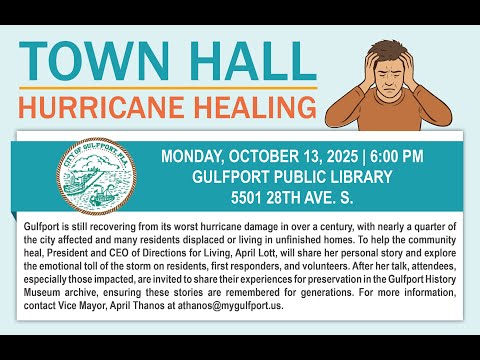
April Lott, CEO and president of Directions for Living, told a Gulfport library forum that mental-health services and kinder, simpler recovery processes must be central to disaster recovery.
Lott, who described evacuating her home on Allens Creek and later losing the lower floor to flooding, said bureaucratic hurdles and financial demands compound survivors’ trauma. “The only words that I should have to use in order to qualify for assistance is ‘I’ve lost everything,’” she said, arguing income-based eligibility and steep contractor deposits leave many without help.
Why it matters: Lott framed the issue as both clinical and practical: clinicians must be able to reach people quickly after storms, and recovery funding and administrative processes should not add to distress. She said Pinellas County reported $5,200,000,000 in losses and was allocated $813,000,000 in disaster-recovery block grants, figures she used to argue the county’s funding strategy should include mental-health investments.
Lott described immediate post‑storm hurdles that residents face: delayed adjusters, contractors asking for large cash deposits, and confusing permitting rules. She said her adjuster arrived “in 7 to 10 days” and that some contractors required deposits as large as $9,000 to get on a service list, a cost she said many households cannot meet. She also said it took “75 days” before her insurance paid anything and that her insurer ultimately left about $75,000 uncovered.
On permitting, Lott said she learned at a City of Largo counter that permits are required not only to replace damaged floors and drywall but also to do basic repairs; she described a prolonged, contradictory permitting process and credited one City Hall employee’s “kindness” with breaking the logjam.
Lott also criticized restrictions on local resiliency grants. She said Directions for Living applied for $50,000 and requested $25,000 to aid staff and clients; an approval letter she quoted said the award could not be spent on staff. “Not a single penny can be spent on your staff,” she read from the letter, and said she refused the money because it excluded the organization’s workforce—about 30% of whom had also been affected.
Speakers and local supports at the forum described widespread community strain: recollections of seeing neighbors’ belongings piled at the curb, staff unable to come to work, and children traumatized by the sights. Lott said community mental‑health providers often cannot bill for immediate emotional support unless a clinical diagnosis is established, and she urged simpler, trauma‑informed intake for post‑disaster services.
She closed with a policy appeal: harden infrastructure without hardening hearts. “Resiliency begins with people,” Lott said, urging pre‑storm planning for mental‑health supports and practical tools—"cheat sheets"—to help residents navigate insurance, contractors and permits.
Next steps: The forum organizers invited residents to record their stories for a city archive and to sign release forms so those narratives can be preserved and used in future outreach and recovery planning.