Get Full Government Meeting Transcripts, Videos, & Alerts Forever!
Get email alerts on the Secondary Education topic
No spam. Unsubscribe anytime.
Consultant: Many Pasco seniors take a 'light' schedule; board urged to boost senior-year math, target recruitment
Summary
A consultant told the Pasco School District board that a majority of seniors take a 'light' senior-year schedule and recommended increasing senior-year math/science participation, targeted recruitment into advanced courses, and reviewing the district's schedule to increase annual instructional time.
A consultant presenting to the Pasco School District board said many graduates take a 'light' senior-year schedule that reduces students' postsecondary momentum and recommended several steps to increase college- and career-readiness.
Steven, the presenter hired for the district's secondary-school analysis, said the team examined four years of course histories for the class of 2025, current school schedules and staffing, and national benchmarks. "You have about 55% of your students not enrolled anywhere within the first calendar year," he said, calling the first 12 months after graduation a strong predictor of whether students persist in postsecondary programs.
The analysis used a 25-point transcript "momentum" score to measure academic intensity, and it found roughly one in four graduates completed coursework the presenters considered highly predictive of postsecondary readiness; about 59'160% of students had a "light senior year" of three or fewer core content courses, the consultant said. "If you get more students signed up for math their senior year," Steven told the board, "you can make some big gains."
The report flagged racial and ethnic gaps in access to advanced coursework (honors, AP, dual credit and IB), with African American and Hispanic students less likely to enroll in advanced math and science despite seats being available. Steven recommended targeted recruitment, earlier advisement beginning in middle school, and family outreach so students and families understand which courses lead to particular postsecondary pathways.
Students who spoke during the meeting echoed the recommendations. One student said they would take a course that was "part of a high school requirement" to graduate; others urged starting a culture of college and career awareness earlier. "I think it's definitely about starting the culture earlier on, like middle school," a student said, recommending more advisory time and programs that connect courses to careers.
The presentation also examined the district's schedule model. Steven noted Pasco's 5-by-3 trimester model provides more elective choices but, in his analysis, yields less annual instructional time per course than common 6-, 7- or 8-period semester models. He estimated (in the presentation) that moving to a six-period semester schedule could lower operating costs by about $600,000 while increasing instructional time, though that tradeoff would reduce elective slots and require careful planning.
Board members asked technical questions about credits, schedules and how a change would affect graduation requirements. District staff clarified that a six-period semester model typically yields fewer credits than the current trimester arrangement and that schedule choices affect both instructional hours and credit opportunities.
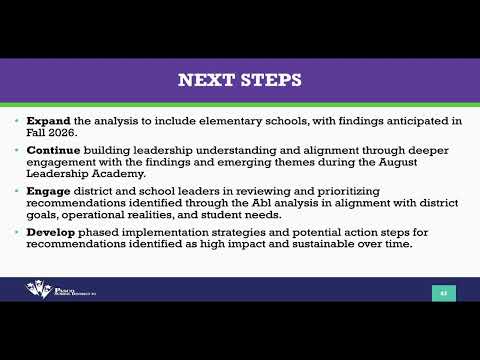
Next steps outlined by the board and staff: the district will complete the elementary portion of the analysis, integrate the findings into leadership work starting in August, and engage school leaders in prioritizing recommendations, with options including increasing advisement, running active recruitment campaigns to fill existing advanced-course seats, or exploring adjusted graduation requirements or schedule models.
The presentation and the board's discussion provided no formal motions or votes; the item was presented for information and next-step planning.