Get Full Government Meeting Transcripts, Videos, & Alerts Forever!
Get email alerts on the Picture Main Street topic
No spam. Unsubscribe anytime.
Northampton committee hears split public reaction as Picture Main Street accessibility plans advance
Summary
At a joint meeting of Northampton City Council and the Community Resources subcommittee, staff presented accessibility-focused design changes for Picture Main Street and a schedule and funding update. Public comment was sharply divided between disability advocates urging urgent ADA upgrades and residents and business owners worried about cost, parking and transparency.
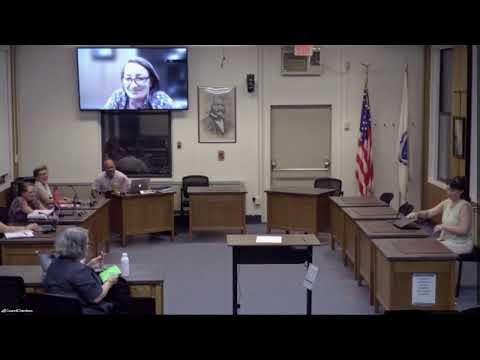
Northampton — City staff and consultants presented a detailed accessibility-focused update on the Picture Main Street redesign and timeline at a joint meeting of the city council and Community Resources subcommittee, drawing sustained public comment both for and against the plan.
The presentation, led by city staff and the project consultant, emphasized widened sidewalks, redesigned curb ramps and crossings, physically separated bike lanes and new bus-stop layouts intended to improve safety for people using mobility devices. The city said it will submit a 100% design to MassDOT next month and that right-of-way negotiations are expected in late 2026 with bidding and construction on the MassDOT schedule in 2027.
Why it matters: Main Street has not seen a reconstruction of this scale in decades, presenters said, and many sidewalks and curb ramps are currently uneven or noncompliant with accessibility standards. Supporters framed the project as an opportunity to fix long-standing hazards; opponents raised alarms about potential costs to the city, reduced parking, and insufficient local input.
What presenters said City presenters described the existing conditions as poor: Main Street pavement was last repaved in 1979 and a 2017 sidewalk inventory rated downtown sidewalks among the city's worst. The consultant cited pedestrian signal wait times that can reach 'up to 119 seconds' at some intersections and noted that an estimated 12% of Northampton residents report a disability. Proposed changes include curb extensions to shorten pedestrian crossing distances, leading pedestrian intervals at signals, wider sidewalks (6–35 feet in places), tactile warning surfaces, and a slightly elevated, buffered bike lane to separate cyclists from parked cars and traffic.
The city also outlined costs and funding sources. Presenters said design expenditures to date total about $4 million and that $11.8 million has been allocated or spent so far. They described a projected MassDOT construction allocation of about $31.5 million and said additional nonparticipating costs (water/sewer, certain furnishings and vault work) total an estimated $7.8 million. "We are on track to submit a 100% design to MassDOT next month in June," a city presenter said.
Public comment: two consistent themes The public-comment period ran long and sharply divided speakers. Disability advocates and people who use mobility devices pressed for faster, more visible accessibility fixes and asked the city to make final plans easily accessible online. Heather Craig, who said she uses a wheelchair and depends on the local paratransit system, asked when the "final plan" will be posted and argued that people with disabilities must be consulted; a city official told the committee that final design documents will be posted as soon as MassDOT completes its review.
Opponents raised concerns about parking loss, disruption to small businesses and funding. Several commenters cited project cost estimates in the tens of millions and asked who would cover overruns. One business owner called mandatory bike lanes "total BS" and said owners had not been adequately consulted.
Claims and disputes Speakers disputed whether municipal funds already set aside for other priorities (including schools) had been diverted to the project, and whether ARPA funds had been applied as claimed. City staff said some local restricted funds and state Chapter 90 and federal allocations are part of the project’s finance plan, and that MassDOT will fund construction once the TIP (Transportation Improvement Program) allocation is finalized.
Council questions and next steps Councilors pressed presenters on whether a trial run could be staged and whether temporary demonstrations would provide reliable data; presenters cautioned that traffic signal timing and other elements mean partial trials can be misleading. Staff said that some tactile warning pads will be specified in cast metal rather than the short-lived plastic commonly seen, and that MassDOT-required stormwater sizing will use the latest NOAA Atlas 14 guidance.
The city reiterated the near-term schedule: 100% design submission to MassDOT next month; anticipated right-of-way work late 2026; plan finalization and bidding in spring–summer 2027; and construction to follow on MassDOT’s timeline. The committee also approved routine minutes and adjourned by voice vote.
What's next: The city said it will post the full 100% design as soon as MassDOT's review allows and will hold additional public sessions this summer focused on test pits, stormwater, trees and bicycle operations. Residents who want follow-up information were invited to submit questions to the council office.