Get Full Government Meeting Transcripts, Videos, & Alerts Forever!
Get email alerts on the Flooding topic
No spam. Unsubscribe anytime.
Key Biscayne workshop outlines model-driven plan: injection wells, outfall upgrades and pipe televising to address Zone 1 flooding
Summary
Engineers presented a detailed model showing Zone 1 (≈93.7 acres) needs a mix of measures — network reconnection, targeted groundwater injection (prelim. 35 CFS), and upgraded outfalls/pumps — and council asked staff for a do‑nothing baseline, storm-frequency analysis and a pipe‑televising cost estimate.
Engineers presented a detailed hydrologic and hydraulic analysis on Zone 1 flooding and laid out a phased approach that would combine reconnection of the existing conveyance network, targeted pressurized groundwater injection wells and upgrades to outfalls and pump stations.
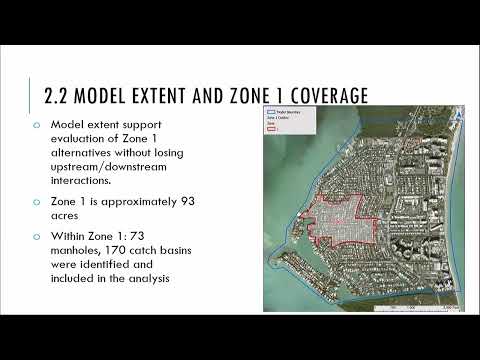
Giorgio, the consultant leading the study, told the Village Council that the numerical model covers roughly 1,000 acres while the focused analysis for Zone 1 covers about 93.72 acres. He said the team’s simulations show the 5‑year design storm (NOAA Atlas 14, 6.56 inches) produces roughly 51.23 acre‑feet of rainfall and an excess surface volume of about 21.70 acre‑feet — “nearly 1,000,000 cubic feet” on the ground — and that, under urban conditions, the model indicates roughly 42% of that excess would require active pumping (about 65.6 cubic feet per second) rather than being handled by infiltration and the existing system.
Giorgio said the project is meant to be phased, not an all‑at‑once rebuild, and listed the options his team will test: optimizing and reconnecting undersized or dead‑end pipes to improve conveyance; installing a small number of pressurized groundwater injection wells to handle localized volumes (preliminary feasibility indicates about 35 CFS could be injected without breaching permitting limits); and locating pump stations/force mains to convey the remaining flow (the consultant cited a remaining need of roughly 30 CFS that would travel to expanded outfalls). “35 CFS can be injected within this area without potentially increasing the groundwater to the level that not it will not be permissible,” Giorgio said during the presentation.
Council members pressed for field verification of the existing outfalls and pipes, noting plan assumptions rely on survey and atlas data rather than camera inspection. Staff member Chris said pumps and backflow preventers were installed several years ago and outfalls have been cleaned, but councillors repeatedly asked for televising to confirm real‑world condition before locking in designs. One councillor urged a network‑wide televising scope to answer whether pipes are clogged, collapsed or leaking and to inform whether slip‑lining or replacement would be required.
Council member Vasquez, who led a line of questioning about model boundaries, said the consultant’s approach differs from earlier work by AECOM by more fully integrating groundwater and tidal effects. “I’m cautiously optimistic,” Vasquez said, noting the approach may reduce costs if permitting and performance align.
Giorgio and staff also flagged permitting as a key next step: the team will meet with the Florida Department of Environmental Protection and county regulators to confirm that the groundwater injection scenarios and mounding analyses meet regulatory tests. Giorgio said the model accounts for sea‑level rise to 2050 (intermediate scenario ~+0.75 ft) and will be used to run sensitivity tests (5‑, 10‑, 25‑ and 100‑year storms and historical extreme events such as Hurricane Irma and mid‑2022 rainfall events).
Council requests and next steps: Council asked staff and the consultant to (1) provide a “do nothing” baseline showing the current level of service and how often thresholds are exceeded, (2) produce storm‑frequency estimates tied to the level‑of‑service thresholds so the council can judge how often streets would be impassable, and (3) return a scoped cost estimate for televising the existing pipe/outfall network. The consultant said a mid‑February workshop will provide more refined results and the process will continue through a final workshop planned for mid‑April.
No formal motions or votes were taken at the workshop; council and staff framed the meeting as an informational and scoping step in a multi‑phase program.