Get Full Government Meeting Transcripts, Videos, & Alerts Forever!
Get email alerts on the Land Use Liquor Store topic
No spam. Unsubscribe anytime.
Zoning board denies request for liquor store at 520 15th Street, citing proximity rules and lack of hardship
Summary
The Tuscaloosa Zoning Board of Adjustments on May 27 denied a variance and a special exception that would have allowed a package/liquor store as part of a multi-use development at 520 15th Street, concluding the applicant did not demonstrate the legal hardship required and that the site fell within prohibited proximity of other restricted uses.
The Tuscaloosa Zoning Board of Adjustments on May 27 denied two linked requests from 1 Investments Inc. to permit a full‑service package/liquor store at 520 15th Street, a redevelopment of the former Bama Bowl site.
Staff presented the requests — a variance (ZBA‑23‑26) and a special exception (CBA‑24‑26) — noting the property is zoned UC and that code requires liquor stores to be at least 1,000 feet from certain uses, including tobacco/vape shops, other liquor stores and some residential districts. Staff said the proposed store would operate inside an ~8,000‑square‑foot mixed use building with a convenience store, a quick‑service restaurant and a 1,400‑square‑foot package store component, and would operate roughly 10 a.m. to 10 p.m. weekdays.
Attorney Cam Parsons, representing the applicant, told the board the developer purchased the corner lot in October 2024 and later discovered the 'framework' zoning changes that instituted the 1,000‑foot restriction took effect Jan. 1, 2025. Parsons said the multi‑lot redevelopment represents “a $7,000,000 development” and argued the combined convenience store, fuel, restaurant and package store are financially interdependent. “This is a substantial investment in the community,” Parsons said, and asked the board to consider vested‑rights and the money already spent on contamination remediation and approvals work.
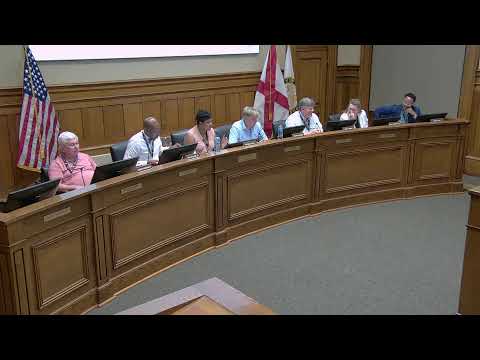
Board members focused their questions on the legal standard for a use variance — whether the applicant had shown a hardship that prevented reasonable use of the property for other purposes. Multiple members pointed to the map staff showed of nearby restricted uses and said the 1,000‑foot radius included several disqualifying uses. Mary Catherine Holt said the map “tells the story” and that the parcel hits “almost everything we don’t need to be near when operating a liquor store.” Chair Michelle Coley said the framework rules were the result of an extensive public process and that, despite the developer’s investment, the board could not simply override adopted separation standards without a demonstrated hardship.
After deliberation the board voted to deny the variance; because the variance failed, the board also denied the special exception. The board recorded the outcome on the public record and noted applicants have the right to appeal the board’s decision to circuit court within 15 days.
The petitioner argued the development’s business model requires all components to operate together and emphasized earlier operation of a nearby package store; the board acknowledged those economic arguments but said the variance criteria require proof the parcel cannot be reasonably used under the code as written. No written public comments were submitted on the request.
Outcome and next steps: Both ZBA‑23‑26 (variance) and CBA‑24‑26 (special exception) were denied by the board. The applicant may pursue an appeal to the circuit court or revise the proposal to remove the package/liquor component.