Get Full Government Meeting Transcripts, Videos, & Alerts Forever!
Get email alerts on the Sewer Infrastructure topic
No spam. Unsubscribe anytime.
New Windsor adopts $109.3 million bond plan to rebuild Caesar's Lane wastewater plant
Summary
Town officials approved a bond resolution to finance construction of a new Caesar's Lane wastewater treatment plant and upgrades to 24 sewer districts after engineers described regulatory orders, capacity exceedances and design choices that drove updated cost and timing estimates.
New Windsor officials on Aug. 1 adopted a bond resolution to expand and rebuild the Caesar's Lane wastewater treatment plant, authorizing an amended appropriation of $109,305,000 and related serial bonds.
Engineer Mike Weeks told the board the existing treatment plant — built in stages beginning in the 1950s with a major expansion in 1974 — is past its expected service life and has repeatedly exceeded its permitted capacity. "We are at the end of life of this plant," Weeks said, describing a history of consent orders and permit modifications since 2008 that led to the current schedule-compliance requirements from state regulators.
The board said design work now sits at roughly 75% complete and that the town has selected a membrane bioreactor treatment process for the new facility because the permit requires more stringent effluent quality. Weeks said the proposed average design flow for the new plant is 8 million gallons per day, up from the plant's statutory permit of 5 MGD, based on a 10-year review of flows, planned projects and vacant-lot analyses intended to make the project "somewhat future proof."
Town officials framed the measure as a regulatory necessity. Steve (a board member and the meeting host) said the upgrades respond to violations and overflow events and that the work is not merely an expansion for anticipated growth. "It's the cost of running this plant for everybody that's in the sewer district," he said while explaining the debt-service planning and short-term borrowing approach that precedes a long-term bond.
On household impacts, the town presented an analysis showing a typical single-family home currently pays about $177 a year for sewer service; the proposed incremental debt service in the short term was described as roughly $265 per typical home, which would raise a representative bill to about $442 per year under the assumptions used in the presentation. Officials said that short-term borrowing will be replaced by a 30-year bond after construction is complete, at which point grant reimbursements and other funding sources will be applied to reduce long-term rates.
Officials said the town has secured and pursued grant funding to lower the burden on ratepayers: a $14.8 million grant was awarded in 2022 and a $4.28 million grant was reported as received; the town is also awaiting decisions on a Water Quality Improvement Program application that could provide up to $10 million. The board emphasized officials are "chasing every dollar" of available grant aid and keeping some reserves to offset immediate rate pressure.
The scope of work was increased during design to include enhanced sludge processing and odor-control measures. Weeks said an added sludge-processing train — roughly a $15 million addition to the project estimate — will let the town produce treated biosolids (Class B) rather than shipping raw sludge out of region; he also said tanks will be covered and odor-control systems will be implemented to reduce neighborhood impacts.
Residents asked about the sudden rise in estimated project cost from earlier, preliminary figures. Resident Dominic said he was "concerned" the price seemed to have doubled in four years; Weeks and other staff explained the earlier $59 million figure was a schematic-level estimate, that 75% design revealed additional required equipment and processes, and that construction-material and equipment pricing has risen substantially in recent years, so final bid results remain uncertain.
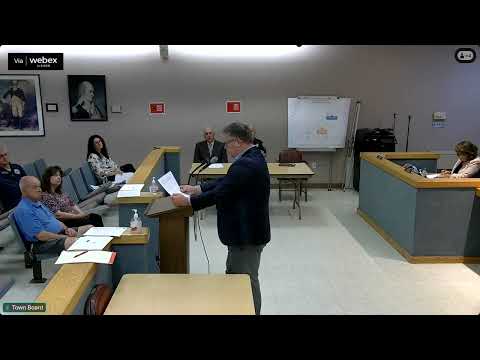
The board closed the 24 sewer-district public hearings, took one consolidated motion and carried a roll-call vote in favor of the bond resolution (Councilman Brock, Councilman Lincoln, Councilman Santiago, Councilman Moro and Supervisor Petti all voting yes). The resolution amends previous bond authorizations (initially adopted Nov. 7, 2018, and amended in 2020 and 2021), increases the appropriation to $109,305,000 for the Caesar's Lane expansion, and authorizes issuance of serial bonds as needed.
Officials said they expect to finish final approvals and put construction bids out in spring next year; town staff cautioned that specialty equipment and supply-market volatility could affect final bids and that the town may break the work into multiple contracts.
The board also handled unrelated business after the sewer hearing, including awarding a drainage-project bid, authorizing intermunicipal water-supply amendments and taking appointments and standard municipal actions before adjourning.