Get Full Government Meeting Transcripts, Videos, & Alerts Forever!
Get email alerts on the Housing Affordability topic
No spam. Unsubscribe anytime.
Pacifica planning commission continues hearing on overhaul of density bonus and inclusionary rules to allow staff-Coastal Commission coordination
Summary
Staff presented a proposal to replace Pacifica's long-outdated density bonus (Article 41) and inclusionary housing (Article 47) ordinances with changes that include longer affordability terms, new AMI tiers, rounding rules, and higher in-lieu fees; the commission unanimously continued the hearing to June 1, 2026 to allow staff to address Coastal Commission comments and return redlined language.
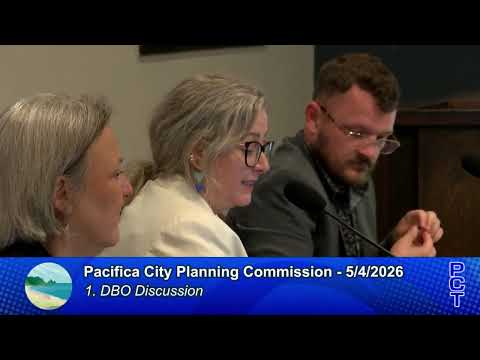
The Pacifica Planning Commission continued its public hearing on a city-initiated text amendment to repeal and replace the city's density bonus (Article 41) and below-market-rate inclusionary housing (Article 47) ordinances, voting unanimously to reconvene June 1, 2026 so staff can coordinate revisions with Coastal Commission staff.
City staff and consultants told commissioners the drafts align local rules with recent state housing law changes, tighten application requirements and findings, and add implementation detail intended to make the ordinances enforceable. "Our recommendation tonight is to hold the hearing, take public comment, discuss, and continue the hearing to allow time to coordinate with the Coastal Commission," Community Development Director Samantha Upgrave said.
Why it matters: Pacifica's density bonus and inclusionary rules were last substantively updated decades ago; staff warned parts of the current code are inconsistent with state density bonus law and therefore difficult to enforce. Consultants from the Housing Endowment and Regional Trust of San Mateo County (HART), Alex Wagner and Tim Davis, described several substantive changes: aligning definitions with state law, requiring application disclosures (tentative maps, phasing), revising affordability terms, and changing how fractional units are handled.
Key proposal elements explained by staff and consultants include: longer affordability periods (staff proposed aligning inclusionary terms to a 99-year standard for rent-restricted units and discussed different terms for for-sale units); revised AMI targeting for inclusionary rental units (introducing 50%, 80% and 110% tiers aiming for an 80% average); rounding rules that require density-bonus fractional units to be rounded up to the next whole unit; new or higher in-lieu ("in-lieu") fee mechanics and a pending fee resolution to update per-unit amounts that were last set in 2007; and new alternatives to on-site construction (off-site construction, off-site preservation, and land dedication) with higher percentage requirements for alternatives.
Commission debate focused on trade-offs and implementation. Commissioner Marge Ferguson asked whether continual ordinance updates are worthwhile given frequent state changes; Upgrave said updating now preserves local process controls and that the city plans a longer-term zoning modernization to make future technical updates simpler. "If our density bonus ordinance doesn't meet state law, we run the risk of losing local control over those provisions," Upgrave said.
On fractional-unit math, commissioners sought clarity about different rounding rules for density-bonus units (state law requires rounding up any fractional unit) versus inclusionary calculations (the city can adopt a rule to require a fee for fractions under 0.5). Alex Wagner said the two systems "stack" and staff will explain how they apply together in the draft language.
Fees and feasibility: Commissioners pushed staff for clearer in-lieu fee numbers. Staff said the existing fee resolution will be updated by council resolution and that the multi-jurisdictional Grand Nexus feasibility study (data due late 2026/early 2027) will inform any substantive fee changes. Staff indicated they will raise the 2007 baseline using the resolution's annual adjustments and present updated per-unit figures with the ordinance package.
Affordability-term debate: Commissioners discussed whether deed restrictions for for-sale BMRs (below-market-rate ownership units) should run longer than the state density-bonus minimums. Staff and consultants noted the state sets minimum durations (for-sale density-bonus units commonly 45 years; rentals commonly 55 years), but jurisdictions may adopt longer terms. A working direction from commissioners was to keep 99 years for rental units and to set a 45-year term for for-sale units that "restarts" at each purchase (i.e., each eligible subsequent buyer receives a full affordability period). Staff said they would draft conforming language and verify legal consistency with state minimums.
Alternatives and decision authority: Commissioners tested the mechanics for allowing off-site construction, off-site preservation (converting existing buildings to deed-restricted affordability), land dedication, and in-lieu payments. Several commissioners said any alternative that involves money or transfer of land should be decided by the City Council rather than by staff or a ministerial review authority; staff agreed to route land dedications and other financial alternatives to council and to tighten objective criteria for approvals.
Concerns that surfaced included parking reductions under state density-bonus allowances (Commissioner Redfield warned that permanent parking loss is a local concern in a largely auto-reliant city), potential unintended consequences of counting "naturally affordable" existing units, and the need to align ordinance language with HCD (California Department of Housing & Community Development) opinions on the evidentiary threshold for denying concessions.
Formal action and next steps: The commission unanimously approved a motion to continue the public hearing to June 1, 2026 to give staff time to address Coastal Commission comments and to return both redlined and clean ordinance drafts for further review. Staff told commissioners they will incorporate the commission's direction, align cross-references, and provide clearer guideline language (e.g., pricing assumptions for for-sale BMR calculations) when the item returns.
The hearing covered numerous technical edits and policy choices, and staff and consultants acknowledged several items would require further legal and HCD review before final adoption. The commission also asked staff to provide a clear matrix or implementation manual that will sit alongside the ordinance to guide developers and staff through application, monitoring and resale processes.
Votes at a glance: The commission unanimously approved the revised agenda order earlier in the meeting (motion by Vice Chair Burman; second by Commissioner Ferguson) and later voted unanimously (7-0) to continue the TA-129-26 public hearing to June 1, 2026. The hearing remains open; staff will return with redlines, corrected cross-references, updated fee resolution numbers, and any Coastal Commission responses.