Get Full Government Meeting Transcripts, Videos, & Alerts Forever!
Get email alerts on the Zoning Update topic
No spam. Unsubscribe anytime.
Consultants outline multi‑phase zoning modernization, public outreach and training plan
Summary
Consultant R.J. Susco of OM Advisers reported that Mount Lebanon's zoning and SALO modernization will move through four phases — launch, diagnose & draft, public engagement/education, and adoption — with public outreach, stakeholder focus groups, an online zoning hub, and adoption targeted for roughly March–April 2027.
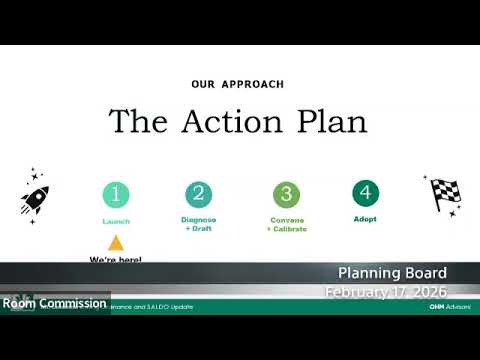
Mount Lebanon’s planning board received a detailed briefing Feb. 17 from consultant R.J. Susco of OM Advisers on a multi‑phase zoning and SALO modernization project designed to update organization, design standards and regulations while preserving neighborhood character.
Susco said the project has four phases: a launch phase (nearing completion), a diagnose & draft phase (heavy code writing), a public engagement and education phase, and the adoption phase. “Vision‑driven with flexibility is the tagline that has been identified for this project,” Susco said, describing the approach the team will use to balance reinvestment and design standards that protect the community’s character.
The team will review municipal master plans, Uptown design guidelines and transit‑oriented development (TOD) policies to align the new ordinance with existing planning documents. Susco said the consultant group will take a context‑sensitive approach to permitted housing types, infill standards and design standards and will integrate green infrastructure and complete‑streets principles in areas near transit stations.
The outreach plan is organized around four stakeholder groups: municipal officials and advisory boards, the general public, the business and development community, and planning partners (including the active transportation team and Alageney County economic development). Susco described roundtable focus groups for business and real‑estate stakeholders, workshops for advisory boards and training on administering the new code. He also said the team will publish an online zoning hub with a zoning map and project materials; municipal staff said the map component may launch around the beginning of next month.
Board members asked for a preliminary table of contents and confirmation that the team would provide an initial diagnostic report and organization plan. Susco said the team will present a diagnostic report and preliminary table of contents at the next steering committee workshop and will return to this body in seven to eight months with a first draft of the code.
Board members discussed recurring variance pain points the team reviewed, including complications from paper streets, frequent fence variance requests on corner lots, and parking/garage replacement rules that can require replacing a garage when homeowners renovate. Susco said the historical variance record — provided to the consultant team that day — will be used to identify where code changes or added administrative flexibility could reduce repeat variance applications.
The consultant emphasized that the adoption phase will include both the statutory public hearings required for code change and community‑oriented celebrations and education to make the new code accessible. Susco said he expects public engagement to intensify later in the process and reiterated that the OM Advisers team will present to the municipal commission next week as part of this launch phase.
The board had no substantive public comment on the presentation and moved on to adjournment.
Next procedural steps: the consultant will return with a diagnostic report and preliminary table of contents; staff will publish the online zoning hub; and the team will schedule stakeholder focus groups and public engagement for the drafting and review phases.