Get Full Government Meeting Transcripts, Videos, & Alerts Forever!
Get email alerts on the Dock Permit topic
No spam. Unsubscribe anytime.
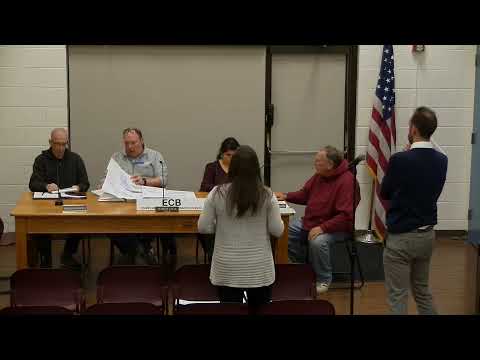
Environmental Conservation Board approves 9 Clara Lane dock replacement with conditions
Summary
The board approved the 9 Clara Lane LLC application Dec. 4, 2025, contingent on submission by noon Monday of a truck-wash plan, soil-stockpile details, a simplified equipment-pad detail, turbidity monitoring procedures, rain-garden calculations and an estimate of removed material.
The Environmental Conservation Board voted Dec. 4, 2025 to accept an application from 9 Clara Lane LLC to replace an existing wood dock, but approved the permit only after attaching several conditions intended to protect the shoreline and town wetlands. The board set a firm deadline: the required materials must be submitted by noon on Monday or the offer to proceed will expire.
The applicants—architect Diana Bravashik, representing Carol Architecture, and civil engineer John Oor of JO Engineering—told the board they had resubmitted revised drawings after an earlier review. Bravashik said the team had addressed prior questions and was prepared to provide more details. Oor described the planned construction methods and said the coffers and dewatering approach would limit disturbance.
Board members pressed the applicants for specific safeguards. The board required: a truck washout location and detail on SK01 showing how concrete washout will be contained outside the regulated buffer; a soil-stockpile detail (silt fence, hay bales or six-mil poly) and a modified "Detail J" making an overnight equipment pad simple (six-mil poly); a turbidity testing and monitoring plan that identifies the meter and how checks will be performed; rain-garden calculations submitted to the town engineer for approval; and an approximate calculation of the volume of material to be removed and the structural material to be used for backfill.
On dewatering, the board said it expected applicants to describe how they will avoid sending fines into the lake. The board noted that typical practice is to use a settling tank or filter blanket and to monitor turbidity during discharge; applicants agreed to provide a turbidity-monitoring plan. The applicants estimated that a high-capacity pump (roughly 300 gallons per minute) could perform the initial dewatering in about half a day, but the board required written monitoring procedures. "I can provide that. Absolutely," Oor said when asked about turbidity testing.
The board also discussed configuration choices for the retaining structure. Members suggested considering plastic sheet piles as an alternative to cast-in-place concrete to reduce formwork and cost; applicants said they had not used that product previously but would evaluate it. The board stressed minimizing excavation of lake-bed material and said applicants should indicate whether some excavated material will be retained inside the cofferdam to settle rather than be removed and dredged.
The motion to accept the application with the listed conditions was seconded and approved by voice vote; specific tallies were not recorded. The board reminded the applicants that the permit will require pre- and post-construction wetlands inspections by the town wetlands inspector and a site visit by the town engineer before work begins. The chair warned the applicants, "Get it done by noon on Monday," and said the application will be advertised through the town process after the conditions are met.
The meeting adjourned after the vote; the board said it will meet again in two weeks.