Get Full Government Meeting Transcripts, Videos, & Alerts Forever!
Get email alerts on the County Budget topic
No spam. Unsubscribe anytime.
Mayor presents $1.1 billion Hamilton County budget with no property-tax increase; public safety and roads prioritized
Summary
Hamilton County’s mayor presented a proposed $1.1 billion fiscal year budget that avoids a county property-tax increase, budgets 2% raises for county employees and directs most new revenue to public safety, health insurance increases and capital priorities including riverfront and road investments.
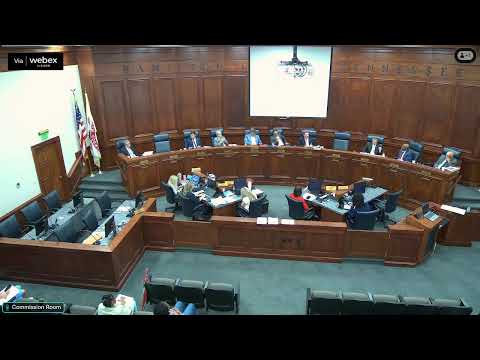
Mayor Wall presented the county’s proposed fiscal-year budget and told commissioners it was “difficult to make balance” but does not include a county property-tax increase; the plan proposes a $1.1 billion total budget, 2% across-the-board employee raises and strategic allocations to public safety, roads and tourism-related projects.
Lee Browner, the county finance lead for the presentation, said the headline revenue increase of $6.6 million is reduced by a $1.88 million lease accounting entry tied to new capital leases and subscription IT agreements, leaving about $4.8 million in operating revenue available for reallocation.
Key priorities and funding choices The mayor said the bulk of new revenue—roughly $4.8 million—was earmarked for public-safety needs, including the sheriff, EMS, volunteer fire and 911, and noted a separate opioid-abatement-funded team (OPT) is now fully planned. To respond to rising health costs the budget includes about a 10% increase in health insurance premiums after prior large adjustments; officials said insurance and pay raises absorb most available revenue, limiting new program funding.
Capital and program investments The county plans capital leases primarily to replace EMS cardiac monitors and automatic external defibrillators across the ambulance fleet; the EMS program also expanded to allow whole-blood transport and training for trauma response. The budget includes $1.4 million in vehicle outfitting for the sheriff’s office, courtroom audiovisual upgrades, technology investments, and continued grants for EV vehicle replacement.
Hotel-motel revenue and the riverfront The administration proposed a bridge funding model for the Chattanooga Tourism Company with the city, and allocated $5 million of hotel-motel revenue toward the county’s share of the Chattanooga Riverfront Park redevelopment (a project with $15 million in state funds and a $5 million city contribution). Officials signaled a likely early-fiscal-year budget amendment as city–county decisions on tourism funding are finalized.
Roads and use of fund balance To address deferred road-safety and capacity projects the mayor proposed drawing additional fund balance to bring cumulative road investments to $15.1 million over multiple years. Commissioners warned repeatedly that relying on fund balance is not a sustainable long-term strategy and urged exploration of other revenue mechanisms.
Process, timing and next steps Officials indicated the commission will likely vote on the budget in mid-June; several commissioners requested follow-up deep dives with finance staff on account reclassifications, maintenance-of-effort formatting and the proposed planning department (due to begin operations July 1). There were no formal votes or motions recorded in the presentation portion of the transcript.
Ending Commissioners thanked staff and asked for targeted one-on-one briefings and finance-committee review before the formal commission vote.