Get Full Government Meeting Transcripts, Videos, & Alerts Forever!
Get email alerts on the Sustainability Plan topic
No spam. Unsubscribe anytime.
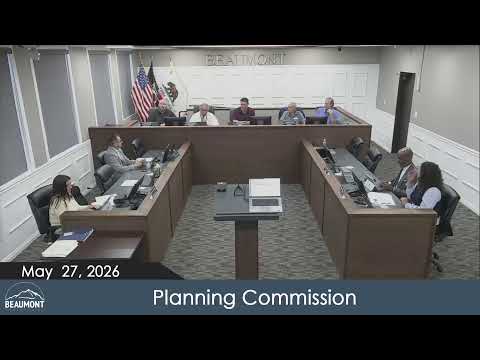
Beaumont Planning Commission recommends 2026 sustainability plan after workshop and debate
Summary
After a workshop and extended Q&A, the Beaumont Planning Commission voted 4-1 to recommend the draft 2026 Beaumont Sustainability Plan to the city council. The plan targets buildings and transportation reductions and outlines 37 sustainability measures and 21 resilience measures.
The Beaumont Planning Commission voted to recommend the draft 2026 Beaumont Sustainability Plan to the Beaumont City Council after a workshop and extended questions from commissioners on May 27.
Sammy Taylor, the consultant presenting the plan, said the city's updated greenhouse gas inventory shows total communitywide emissions in 2022 of about "376,700 metric tons of carbon dioxide equivalent," with on-road transportation accounting for roughly 63% of those emissions and residential and nonresidential energy use around 28%. Taylor said those results shaped the plan's focus on building efficiency and transportation changes.
The draft plan updates Beaumont's 2015 plan with implementation-focused actions intended for a roughly five- to 10-year horizon. Taylor said it contains 37 community sustainability measures across buildings and energy, transportation and land use, solid waste, water and ecosystems, and accountability; the plan also includes 21 community resilience measures addressing emergency preparedness and support for vulnerable populations.
Commissioners pressed staff and the consultant on how many measures would be mandatory versus voluntary, funding and incentives, and the accuracy of hazard maps. "We relied on state-provided data," Taylor said in response to questions about wildfire risk and mapping, noting the vulnerability assessment uses sources such as Cal-Adapt and new wildfire hazard severity zone maps and projects trends over a 50- to 100-year horizon.
Stephen Jones, Beaumont's community development director, described implementation pathways: many measures would require later code changes or program development. "We could look at that when the next title is updated," Jones said when commissioners raised the possibility of adding efficiency standards to building codes; staff said the next code cycle is expected in 2028.
On transportation, Taylor said the inventory uses an origin-destination methodology that excludes pass-through freeway traffic, so the 63% figure reflects trips that start or end inside Beaumont. The plan proposes exploring transportation demand management, active-transportation improvements, and siting for electric vehicle chargers, but staff emphasized that many actions are exploratory and would require regional coordination and further study.
Solid waste language in the draft references state organics-diversion requirements (recorded in the meeting as "SP 1383"); staff said the plan focuses on education, technical assistance and implementing state requirements for organics collection. Water and ecosystem measures include pursuing a parks master plan and an urban forest master plan in partnership with the Beaumont Cherry Valley Parks District.
After discussing implementation capacity, enforcement pathways and coordination with regional partners, the commission moved to recommend the plan to city council; the motion passed on a roll call vote of four in favor and one opposed.
Next steps: the plan remains out for public comment as it proceeds to city council, where council members will consider written feedback and the commission's recommendation before any final adoption vote.