Get Full Government Meeting Transcripts, Videos, & Alerts Forever!
Get email alerts on the Housing Affordability topic
No spam. Unsubscribe anytime.
Woodstock committee to study two town-owned parcels for affordable housing
Summary
The Woodstock Housing Committee reviewed stage-2 site analyses for three town-owned parcels, heard options for housing types and financing (including LIHTC and HCR programs), and agreed to gather community input before recommending two parcels for stage-3 schematic designs funded in part by ARPA.
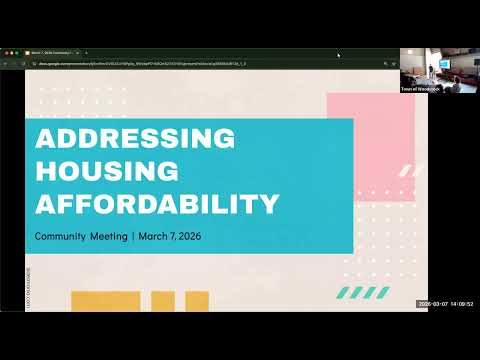
John Cooper, cochair of the housing committee, opened Saturday’s community session by saying the housing shortage affects the whole town — long‑time residents, artists and local businesses — and framed the committee’s work as exploratory rather than a commitment to build.
“We talked to seniors who say that they know the house that is hard for them to maintain,” Cooper said, describing displacement pressure on established residents. He summarized the meeting’s three goals: explain the problem, review potential town parcels and collect public input to guide a recommendation.
Cathy (introduced at the meeting by Cooper) outlined planning principles and financing tools the committee has considered, including New York’s Smart Growth guidance, the Environmental Protection Fund, and federal programs. She said area median income (AMI) for Woodstock in 2026 is about $119,800 for a family of four and explained that affordable housing typically costs no more than 30 percent of household income. Cathy also described common housing types under consideration — low‑rise apartments, cottage clusters, multifamily homes and townhomes — and reviewed funding mechanisms such as the Low‑Income Housing Tax Credit (LIHTC) and New York State Housing Finance programs.
Rebecca Brooks, a housing committee member, summarized the Town‑Owned Parcels Project. The committee screened 34 town properties, issued an RFP in October 2024 and hired Fisher Associates to carry out a three‑stage analysis funded in part by American Rescue Plan Act (ARPA) allocations. Brooks said Fisher’s stage‑2 reports — including Phase I environmental site assessments — found no contaminants in the buildable areas of the three shortlisted parcels and delivered engineering analyses of site geology, utilities, wetlands and other constraints.
“Those reports are lengthy,” Brooks said, “and they are available on the housing committee site.” She emphasized that the committee is not deciding to build yet; the next step is to choose two parcels for stage‑3 schematic designs and return to the community.
Consultant Gregory Stanford presented the first parcel, a 31‑acre site off Zeno Road that is largely rural. He said roughly one‑third of that site is buildable because wetlands bisect the property and that Fisher’s high‑level estimate suggests the buildable area could accommodate up to about 50 units. Stanford cautioned, however, that the site has extensive ledge and shallow bedrock, would require wells and septic systems (there is no town water/sewer), and likely would incur high excavation and foundation costs.
Rebecca Brooks reviewed the second parcel, Xena Highwoods (about 11.1 acres). Fisher’s schematic capacity for that parcel is roughly 40 units, but Brooks noted only about 3.7 acres appear buildable because of slopes and setbacks. The site lacks town water/sewer, may require deep wells because of shallow bedrock, and the stage‑2 analysis flagged potential habitat for threatened bats and monarch butterflies, which could trigger DEC and wildlife approvals.
Cooper and the committee then described the third site — the Mountain View parking lot, roughly 2.5 acres with about 100 parking spaces in current use. Cooper said that lot is the most straightforward to develop because it already has town water and sewer, is relatively flat and is served by transit, which reduces infrastructure costs. He also presented parking counts collected May–September showing at least about 50 empty spaces at peak times and said the perception of a parking shortage is driven in part by signage and wayfinding: “Parking functions are rare, but people don't seem to know where the parking is,” Cooper said.
The committee did not take a formal vote. Next steps are to collect community feedback at the meeting’s breakout tables, have Fisher Associates use that input to prepare stage‑3 schematics for the two parcels the committee recommends, and return drafts to the public for further comment. The housing committee noted staging and funding remain open questions and that any development would require additional engineering, environmental approvals, programming decisions (what AMI band to serve) and developer interest.
Officials and consultants referenced programs and agencies they will use in later stages, including LIHTC, New York State Homes and Community Renewal (HCR) financing, and federal ARPA funds that covered Fisher’s work. Information and the stage‑2 reports are posted on the committee’s housing project site for public review.