Get Full Government Meeting Transcripts, Videos, & Alerts Forever!
Get email alerts on the Building Permit Fees topic
No spam. Unsubscribe anytime.
Board debates whether to show $500K in Electric Boat permit revenue or fund $300K inspector from undesignated funds
Summary
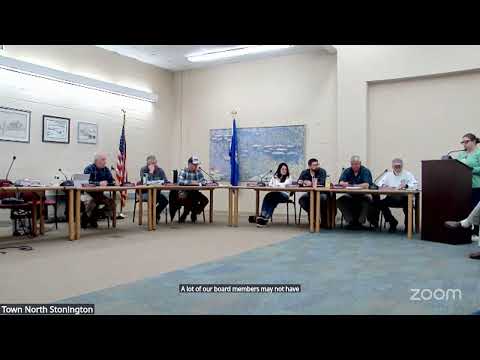
The North Stonington Board of Finance spent the meeting weighing whether to include unusually large building‑permit revenue and a matching inspector expense for a multi‑building Electric Boat project on the referendum budget or to treat the inspector pay as a one‑time appropriation from the undesignated fund while tracking revenue separately.
The North Stonington Board of Finance on March 30 spent the bulk of its meeting wrestling with how to record unusually large building‑permit fees and the cost of hiring a dedicated building inspector for a multi‑building Electric Boat project.
Town staff told the board the foundation permit and future subcontractor permits for the project will generate roughly $500,000 in permit revenue and that the town is likely to need roughly $300,000 in inspector fees to meet inspection demands. "We know in this particular case, all revenue is coming in prior to our spending," said Bob Carlson, who outlined a proposal to treat the project like a special appropriation so voters at the town meeting could hear the full explanation.
Board members split on presentation. Some argued the budget front page should show both the $300,000 expense and the offsetting revenue so voters see the net effect. "If you put the revenue in and you put the expense in, who is going to see it? It's a budget — the taxpayer should see the net," said a board member pressing for full visibility. Others warned that listing the expense without immediate and obvious revenue offsets could artificially inflate the referendum figure and risk defeat at the ballot box; they favored an appropriation from the undesignated fund that would be replenished as permit fees arrive.
The board discussed other options used by neighboring municipalities, including a customer‑funded escrow or project fund for unusually large, nonrecurring projects. Board members also raised procedural questions: whether the town could place the inspector cost as an appropriation at the town meeting, move revenue recognition to the town P&L, or simply add a special budget question for voters to decide. Carlson said the town can track the receipts through QuickBooks and return funds to the undesignated fund when the revenue arrives.
Members asked staff for firmer timing and amounts because permit revenue may span fiscal years depending on construction schedules. "We know we're going to be between 280,000 and 300,000 roughly for that building inspector fees, and we know we're going to be between 500,000 and 600,000 in revenue," Carlson said, adding that some permit revenue (foundation fees) is already in hand.
Without a fully settled approach, the board moved a procedural motion directing the Board of Selectmen budget to be adjusted to account for the building‑permit revenue and the inspector expense so the numbers can be modeled together during final budget calculations. The transcript records the motion and an affirmative voice vote but does not list a detailed roll‑call tally.
The board also discussed whether to earmark roughly $340,000 from the undesignated fund to cover short‑term uncertainty tied to a separate state legislative issue affecting solar‑farm assessments. Several members said using undesignated funds in this one‑time manner would avoid overtaxing residents in a revaluation year while the legislative issue is resolved.
Next steps: staff will supply refined revenue and expense timing, a 'waterfall' scenario showing mill‑rate impacts under different treatments (include both lines, treat expense as appropriation, or track via P&L), and options for how the town can present the question at the town hearing and town meeting.