Get Full Government Meeting Transcripts, Videos, & Alerts Forever!
Get email alerts on the Property Tax topic
No spam. Unsubscribe anytime.
Tax assessor Luke Vigu explains how the town’s property tax rate is calculated
Summary
Luke Vigu, the town tax assessor, demonstrated a sample calculation showing how taxable value and the dollar amount the town needs to raise determine the mill rate, and outlined two basic ways an individual taxpayer’s bill can change.
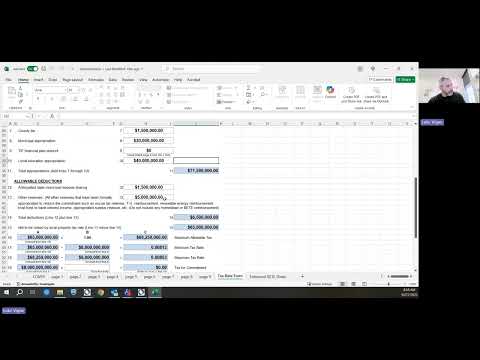
Luke Vigu, the town tax assessor, walked listeners through how the town’s property tax rate is calculated, using a sample worksheet and figures drawn from the municipal valuation return provided annually by the state.
Vigu said the calculation begins with the town’s total taxable value of real estate — in his example, $4 billion in land plus $4 billion in buildings, or $8 billion — and the dollar amount the town needs to raise for the year, which he listed from the warrant as $71,500,000. He then subtracts other nonproperty-tax revenues to arrive at the amount to be raised by property tax.
"I have uh brought up my tax rate calculation form. It's actually uh the municipal valuation return provided to us by the state annually," Vigu said as he opened the demonstration. He read a list of voter-authorized revenue items that reduce the town’s reliance on property tax, including auto and boat excise, cable franchise fees, tower-lease revenue, investment interest, road subsidy, parking fines and meters, plumbing permits, town clerk fees and transfer-station permits.
After accounting for other revenues, Vigu said the example required $65 million to be raised by property tax. He demonstrated the math: dividing $65 million by the $8 billion taxable value gives 0.008125. "That number is your mill rate," he said, and noted it rounds to a tax rate of $8.13 per $1,000 of assessed value.
Vigu outlined two ways an individual property owner’s tax bill can fall. First, an owner’s assessed value must decline relative to everyone else’s — a uniform reduction in assessed values across the board would change the mill rate but not individual bills. Second, the town can lower the dollar amount it needs to raise. As an illustrative example, Vigu said reducing the amount to be raised by $10 million lowered the tax rate by roughly $1.15 in his worksheet; he acknowledged some of the spoken example numbers were unclear in the recording.
This presentation was informational; the assessor did not propose or move any formal actions during the recording.