Get Full Government Meeting Transcripts, Videos, & Alerts Forever!
Get email alerts on the Open Records topic
No spam. Unsubscribe anytime.
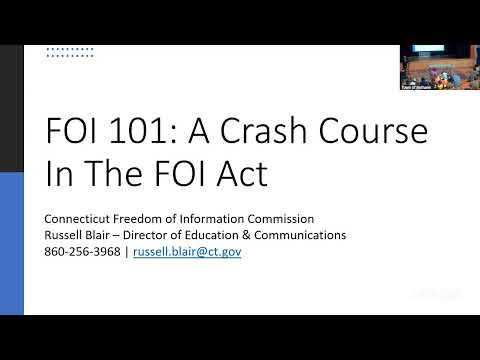
Freedom of Information Commission trainer advises Bethany officials on records, meetings and complaint risks
Summary
Russell Blair of the Connecticut Freedom of Information Commission led a training for Bethany officials outlining public-records duties, common exemptions, timelines for responses (acknowledgement within four business days), limits on charging staff time, and penalties for violations.
Russell Blair, director of education and communications at the Freedom of Information Commission, told Bethany town officials that Connecticut's FOI law — passed in 1975 — has two fundamental parts: access to public meetings and access to public records. "We have one of the strongest laws in the country and also we have pretty strong enforcement of that," he said, describing the statute's history and purpose.
Blair walked through practical obligations for local boards and staff. He said requests must be in writing (email or letter suffice), towns must produce existing records but are not required to create new documents or answer policy questions, and staff time ordinarily cannot be billed to requesters. "You do not have to answer questions, do research, or create records that do not already exist," he said.
He noted standard operational rules: acknowledge every FOI request within four business days; offer inspection free of charge; charge only for copies and, in limited cases, third-party vendor work; and require prepayment when costs exceed $10. "If a cost of an FOI request is going to exceed $10, you're allowed to ask for prepayment," Blair said.
Blair illustrated how coverage depends on context. Volunteer fire departments are subject to FOI for public-fund expenditures and public-safety matters but not for social or fraternal business. Libraries may or may not be covered depending on their governance and ties to the town; patron records generally remain confidential even when a library is covered.
He urged officials to rely on legal exemptions when withholding records: attorney-client privilege, trade secrets, health and student records, and other statutory protections. When in doubt, Blair recommended consulting counsel or the Commission, saying denials must rest on a legal basis rather than political preference.
The session closed with practical tips: file agendas in the town clerk's office, record votes and attendance in minutes, treat a hybrid meeting link as a meeting location, and respond promptly when FOI requests arrive to avoid complaints and possible hearings. Blair offered his contact information for follow-up questions and training requests.