Get Full Government Meeting Transcripts, Videos, & Alerts Forever!
Get email alerts on the District Budget topic
No spam. Unsubscribe anytime.
Brookings-Harbor SD 17C adopts 2026–27 budget, levies $33.2494 tax; warns of further cuts as enrollment declines
Summary
Brookings-Harbor SD 17C's budget committee elected its leadership and approved the 2026–27 budget and a permanent tax rate of $33.2494 per $1,000. The district projects a $1.4 million reserve but said long-term funding pressure from declining enrollment will likely require more reductions.
Brookings-Harbor SD 17C’s budget committee voted to approve the district’s 2026–27 budget and to impose a permanent tax rate of $33.2494 per $1,000 in assessed value after a public meeting that included the district’s budget message and questions from committee members.
Helena, the budget presenter for the district, opened the presentation with the district’s priorities: ‘‘we believe every student can succeed,’’ she said, framing the proposed budget around student supports, staff recruitment and retention, and fiscal sustainability amid a long-term enrollment decline.
The 2026–27 general fund budget projects an ending reserve of about $1.4 million, roughly 7% of general fund expenditures, down from the roughly 12% reserve at the end of 2024–25. Helena told the committee the district set a board target of 7.5% and that the projected reserve ‘‘is aligned with the school board’s long-term target’’ while noting that a persistent drop in enrollment will likely require additional staff reductions in future years.
Committee members pressed for details. The budget includes reductions of four licensed positions and 5.5 classified positions to occur through attrition, the presenter said, and highlighted one-time revenue that helped in 2026–27: reinstated federal forest fee revenues and a roughly $2.7 million carryover that included a multi-year back payment. ‘‘One reason it’s $2.7 million instead of $1.7 is because we got a one-time federal forest payment that was back pay from 2021 to 2025,’’ Helena said, adding that those funds are not a permanent solution to long-term revenue pressure.
The committee discussed how state funding is calculated per student and how special weights (for special education, English-language learners and other categories) affect per-pupil allocations. A figure cited in the discussion for the weighted per-student amount was about $11,500; committee members noted that the additional costs of some special education placements can far exceed the weighted revenue for those students.
Helena reviewed program investments supported by targeted grants: early literacy and federal literacy grants that fund high-dosage tutoring, a grant-funded BCBA behavior specialist paid through Title funds, and an expansion of CTE offerings including a culinary instructor who will teach Spanish and culinary. The district also partners with an online alternative provider (identified in the packet as Grad Alliance) for GED and alternative-program students; the contract line of about $80,000 for professional and technical services reflects that partnership, Helena said.
Committee members and presenters also discussed the district’s failed bond measure and the lost opportunity for state matching funds. ‘‘Our school bond did not pass. So, the sad part is we lost $6.1 million in matching bonds,’’ Helena said; members discussed timing for a future bond and the outreach strategy needed for another attempt.
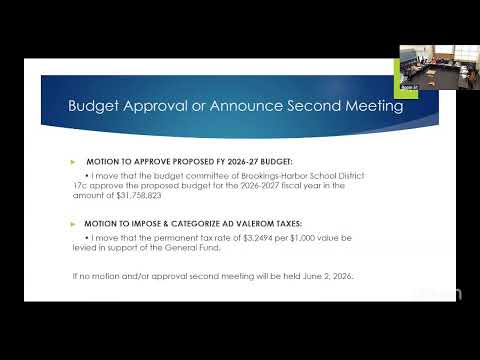
On motions, a committee member moved to approve the 2026–27 budget (referred to in the motion as budget 17C). The committee voted to approve the budget; a separate motion to impose the permanent tax rate of $33.2494 per $1,000 in assessed value to support the general fund also passed. Roll-call responses during the votes included multiple committee members saying ‘‘I’’ (the meeting record indicates unanimous approval for the budget and tax levy at the committee level).
The presenter and committee noted next procedural steps: filing the adopted budget with the county recorder and, for expiring committee terms, soliciting renewal or new applications for July board action. The meeting closed after committee members thanked staff and reviewed possible next meetings if further action is needed (for example, if a seismic grant were awarded and required budget adjustments).
What’s next: The board will receive the committee’s recommendation; the adopted budget year begins in July when the district files the adopted budget with the county. Committee members were warned that, despite one-time forest payments and some grant funding, continuing enrollment declines and rising costs mean the district may need further reductions in future budget cycles.