Get Full Government Meeting Transcripts, Videos, & Alerts Forever!
Get email alerts on the Transportation topic
No spam. Unsubscribe anytime.
Los Altos commission recommends county pursue Foothill Expressway Alternative 1, stresses intersections and funding clarity
Summary
After reviewing Santa Clara County's Foothill Expressway multimodal feasibility study, the Los Altos commission signaled support for Alternative 1 (a largely Foothill-based 10-foot Class I path) while urging the county to prioritize intersection safety improvements, provide cost estimates, and coordinate connectivity with city streets.
Los Altos commissioners reviewed Santa Clara County's Foothill Expressway multimodal feasibility study and told county staff they prefer Alternative 1, a continuous Class I multimodal path largely within the Foothill Expressway right-of-way, but stressed that intersection improvements, funding, and detailed design work must be resolved before construction.
The county presenter (Stephen) told the commission the feasibility study evaluated roughly a 10-mile corridor and that public outreach produced about 90 responses, 58 of which came from Los Altos residents. He said the county's two principal alternatives are: Alternative 1, which keeps the multimodal path principally within the Foothill footprint and would be built under county jurisdiction; and Alternative 2, a blended approach that shifts segments onto frontage and neighborhood streets, which would require multi-jurisdictional coordination and likely city investment.
Why it matters: commissioners and residents agreed the study's intersection proposals — removing slip-right lanes, squaring corners, adding high-visibility crosswalks, ADA ramps and signal bicycle preemption — would have immediate safety value. Commissioners repeatedly urged the county to prioritize those intersection changes even if funding or the full corridor build are years away.
Funding and timeline: commissioners asked whether the county had identified construction funding or cost differences between the two alternatives. County staff said no city funding request had been made to date and that the county is asking local agencies for a directional preference so consultants can move to design; staff confirmed the study itself does not include full construction cost estimates and that grant opportunities (for example ATP-style competitive grants) typically return on a multi-year cycle.
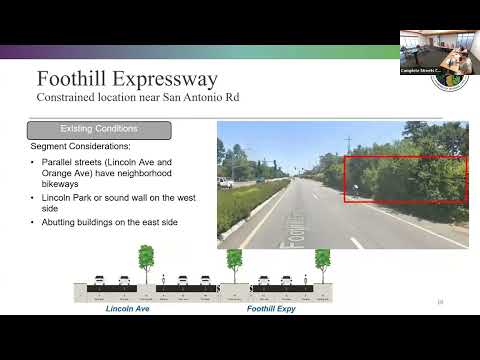
Constraints and design concerns: the county presentation called out physical constraints that will affect where the path can be placed — vegetation buffers, sidewalls, grade differentials near Lincoln Park, and narrow cross-sections — and described the need for wayfinding where the path shifts from one side of Foothill to the other. Commissioners and public commenters warned that squaring corners without addressing deceleration/acceleration lanes could create backups and safety conflicts for motorists and bicyclists.
Public comments: local residents who spoke at the meeting urged protected bike lanes on Foothill, faster pedestrian-priority signal timing at some crossings, and careful traffic analysis at key intersections. Jim Wing, who said he walks many of the crossings daily, warned that some proposed corner changes "could cause traffic jams" unless turn/acceleration lanes are extended; another resident said intersections are the one element the public overwhelmingly supports and urged the commission to press for them.
Commission direction: commissioners generally favored Alternative 1 (keeping the corridor within the Foothill footprint) while asking staff to tell the county three points: (1) prioritize intersection safety improvements; (2) return with design-level vetting and traffic analyses for problematic locations; and (3) clarify funding responsibilities and likely city costs if local streets would be used. Commissioners also said the city can pursue connectivity projects on its own frontage roads to complement a county-led Foothill solution.
Votes at a glance: the commission approved the minutes for the regular meeting of the 29th and the joint meeting on the 22nd by voice vote earlier in the session (motion moved and seconded; transcript records "eyes in favor. Approved"). No roll-call tally was provided in the transcript.
What happens next: staff will convey the commission's directional preference (support for Alternative 1, with intersection prioritization and requests for design and funding clarity) to county project leads and ask consultants to proceed with the next design steps only after resolving jurisdictional and funding questions. The commission also asked staff to return with any cost estimates and traffic analyses when available.
Representative quotes from the meeting: "The public would like to see Alternative 1," Stephen said in his presentation, summarizing outreach responses. "If you square these corners coming off of Foothill, you have to extend deceleration lanes or you'll jam traffic up on Foothill Expressway," said Jim Wing, a longtime local pedestrian who spoke during public comment. "If nothing else, do these intersections," a resident urged, reflecting the consistent public support for intersection improvements.
Ending: Commissioners closed the Foothill discussion by asking staff to relay the preference and to press the county for design-level studies, funding clarity and a focus on intersections before any construction phase begins. Staff will report back as the county advances design and funding plans.