Get Full Government Meeting Transcripts, Videos, & Alerts Forever!
Get email alerts on the Budget topic
No spam. Unsubscribe anytime.
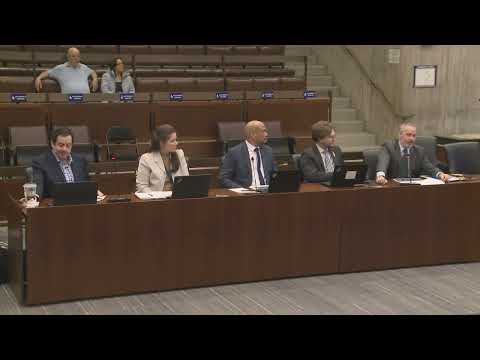
Council committee grills Assessing, Auditing and Treasury as FY27 budget review continues
Summary
At a May 26 Ways and Means hearing, city auditors and finance officials outlined operations and FY25–26 workload while councilors pressed on falling downtown office values, capital‑plan equity and audit controls; public commenters urged action on community centers and EMS facilities.
Chair Ben Weber opened the Committee on Ways and Means hearing on May 26, 2026, saying the session would review the Assessing, Auditing and Treasury departments and the city’s FY2027 capital plan and five‑year capital program.
City Auditor Scott Finn told the committee his office’s mission is to present a complete and accurate statement of the city’s finances and to provide technical assistance across departments. He said the auditing office processed roughly 146,000 vouchers in FY25, reviewed about 2,200 contracts and helped produce the city’s annual comprehensive financial report and single audit (the 2024 single audit covered 12 federal programs). "We prepare the city's annual financial statement," Finn said, describing the office’s role in controls and procurement review.
Commissioner of Assessing Nick Anello described the department’s responsibilities for valuing more than 190,000 real‑estate and personal‑property accounts with a combined assessed value he said exceeds $295 billion. He reiterated that assessments are set to reflect value on a fixed determination date and therefore are "backward‑looking," which can create the appearance of mismatches when high‑value sales occur after that date.
Treasury officials described collections and cash‑management operations, noting collection rates near 99.1–99.2% in recent years and monthly payroll and vendor flows. The collecting division reported multi‑year recovered collections (roughly $19.6 million in FY23, $25.5 million in FY24 and $26.1 million in FY25) and said it aims to improve online payment services and QR integration on bills.
Council members used the hearing to press for more transparency and neighborhood equity in the capital plan and to question assessment methodology, data quality and staffing levels. Several members expressed concern that citywide and "multiple‑neighborhood" budget categories can obscure which neighborhoods are receiving concrete investments. Deputy Budget Director and Director of Capital Ian Donnelly said citywide classifications cover annual programs (repaving, street reconstruction) that operate in every neighborhood while "multiple neighborhoods" covers discrete projects that span more than one area.
Public testimony highlighted community concerns. Gregory Maynard and other commenters urged more accurate revenue forecasting and fiscal discipline; community speakers from Allston‑Brighton and Roxbury urged investment in the Jackson Mann community center and in Boston EMS infrastructure, saying facilities are undersized and in need of renovation.
The committee did not take votes at the hearing. Chair Weber closed the session by thanking staff and reminding members that the council’s budget deliberations continue.