Get Full Government Meeting Transcripts, Videos, & Alerts Forever!
Get email alerts on the Budget topic
No spam. Unsubscribe anytime.
Ulster board amends 2026 preliminary budget to preserve staffing, restore board health insurance
Summary
The Town of Ulster Board voted to amend the 2026 preliminary budget to maintain proposed personnel levels, reinstate health insurance for town board members and keep the tax levy at the 2% cap after an extended public comment period focused on police staffing and safety.
The Town of Ulster Board on Oct. 28, 2025 approved a motion to amend its 2026 preliminary budget to preserve proposed staffing levels, reinstate health insurance for town board members and set the tax levy at the 2% state tax-cap, board members said.
The measure, taken as a package, directs the deputy supervisor and the controller to present other options to reduce budgeted expenses without cutting personnel and to recommend by Nov. 20 what fund balances could be used to balance the budget. The board said the revised preliminary budget must be adopted on Nov. 20 to meet the county filing deadline on Nov. 21.
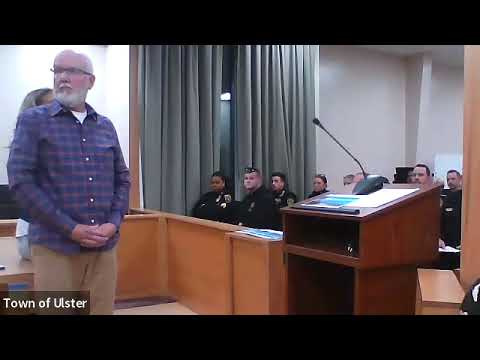
Why it mattered: dozens of current and former police officers, dispatchers and residents urged the board during a lengthy public-comment period not to cut departmental positions and to invest in staffing. Chief Bardi, who has led the department for eight years, described rising call volume and complex investigations and asked the board to maintain the department’s capacity. “As the police chief for the last eight years, I have watched this town provide support for the growth of business and development. All I ask from you today is to provide that same support for the growth of this police force,” Chief Bardi said.
Patrol Sergeant Sean Bailey told the board the department is stretched thin: "Our detective division currently consists of a detective sergeant and only three detectives," Bailey said, and detectives are often pulled from investigations to answer patrol calls. Dispatch staff and officers provided daily call-volume figures and examples of high-acuity cases the department handled recently to illustrate the operational strain.
Fiscal context: resident Regis Soki urged the board to use accumulated reserves rather than increase taxes, citing an unspent-cash accumulation he described as "nearly $22 million" and proposing a 10-year capital plan and asset inventory. Board members responded that they planned to draw some fund balance this year to avoid breaching the tax cap while maintaining staffing, and that staff would present detailed options by Nov. 20.
The vote: the motion passed on roll call with three votes in favor and two members absent. The minutes recorded Supervisor Quigley as not present; Councilwoman Degrroot voted yes; Councilwoman Hayner not present; Councilman Shatzel voted yes; Councilman Van Cleek voted yes. The board said the amendment protects personnel lines in the preliminary budget, incorporates specific police salary/benefit corrections noted in an Oct. 25 email, and restores board health insurance that had been discussed earlier in the review.
Other actions: the board unanimously approved a package of routine items, including authorization for the controller to attend the Association of Towns training in February 2026, renewal of Guardian dental/vision and Lincoln disability insurance plans, an employee transfer from sewer to highway, acceptance of a long-time employee’s retirement, and several part-time hires. The board also authorized the deputy supervisor to sign a STOP-DWI high-visibility enforcement agreement (Oct. 1, 2025–Sept. 30, 2026).
What’s next: staff will present a revised preliminary budget at the Nov. 20 meeting; if the board approves it there, the budget will be filed with the county on Nov. 21. The board also indicated it will continue regular monitoring of fund balances and departmental expenditures.
(Reporting note: article draws exclusively on the public meeting transcript.)