Get Full Government Meeting Transcripts, Videos, & Alerts Forever!
Get email alerts on the Beach Renourishment topic
No spam. Unsubscribe anytime.
Isle of Palms resilience committee seeks data access and early input on $32 million beach renourishment; asks about emergency sandbags
Summary
At its Feb. 5 meeting the Isle of Palms Resilience Committee agreed to press for three check-ins with the city's alternatives consultant, requested Stephen (city engineer) present minimum-healthy-beach calculations in March, and raised urgent questions about short-term sandbagging for at-risk Beachwood East properties ahead of a March 30 king tide.
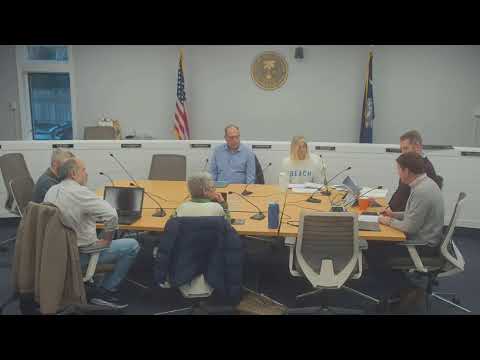
Isle of Palms — The newly formed Isle of Palms Resilience Committee met Feb. 5 and asked city staff for clearer data and more frequent technical briefings as the city prepares a roughly $32 million beach renourishment project this year.
Douglas Carr, Isle of Palms city administrator, opened the session and said he will staff the committee initially, with the city planning to move responsibility to a future resilience officer: "I will be here as needed at least initially this body," Carr said. He told members the committee is advisory to City Council and will not make binding decisions but can provide technical recommendations.
Why it matters: Committee members framed their role as an oversight and advisory check on both near-term emergencies and long-term strategy. Several members argued the group should review the engineering analyses that underlie permit volumes, cost estimates and the "minimum healthy beach" metric that triggers renourishment action.
Members pressed staff for three scheduled interactions with the city's alternatives consultant, F.A. Olsson (the transcript uses several spellings of the consultant's name). Carr agreed to request early, mid-study and final briefings so the committee can review pros and cons of structural options such as groins or geotubes and provide informed recommendations.
"If we're going to be discussing things that we think are beneficial... it would be helpful to have at least some interaction with them so we can have a better understanding of what the pros and cons are," said Dan Slover, a resident member of the committee.
Data and permit-volume concerns: Member Wendy Pastrick said her own tally of sand losses on the south end exceeded the permit volumes and the committee's "minimum healthy beach" numbers, urging staff to bring the raw monitoring data and calculations to the next meeting. "I looked at what [the consultant] put in the permit... the volume deficit that's on the piece of paper is much less than what we've actually lost," Pastrick said.
City staff replied that the previous ad hoc committee and the city's consultant Coastal Science & Engineering (CSE) produced the minimum-healthy-beach benchmarks, but agreed to have Steven Traum (city engineer/project manager) present the 2025 monitoring report and walk the committee through how the metric was derived at the March meeting.
Short-term protection and emergency sandbags: Members also asked whether the city will refresh sandbags at Beachwood East before a March 30 king tide to avoid immediate property loss. Staff said there is no preexisting city plan to refresh sandbags and that historically emergency sandbagging has often been reactive and sometimes carried out by property owners. Carr said the city can issue emergency orders and has previously supported some emergency protections, but that funding and policy choices matter.
Funding and recurring sand sources: Staff outlined the financing context — the city collects a 1% accommodations tax dedicated to a beach preservation fund, but Carr said the fund still faces roughly a $10 million shortfall for the upcoming project. Members discussed trade-offs between paying for larger initial volumes versus repeated smaller emergency efforts.
Separately, staff highlighted Army Corps-connected dredging work that may yield recurring sand deliveries from the intracoastal waterway. The city's presentation said an intercoastal dredge contractor could provide roughly 200,000 cubic yards every two years, which could help offset erosion if that sand can be routed to the beach.
Next steps: Staff committed to (1) request three check-ins with F.A. Olsson during the alternatives study, (2) arrange for the city engineer to present minimum-healthy-beach calculations and the 2025 monitoring report at the March meeting, and (3) circulate the prior ad hoc committee's funding recommendations for the group's review. The committee formally moved to adjourn at the end of the session.
Context note: Transcript spellings for some consultant and contractor names varied during the meeting (examples include "FA Olsson," "Footh Olsson," "Olson," and contractor variants such as "Kotrol"). The article uses the consultant label as presented in the meeting but flags the transcript inconsistencies and relies only on material discussed in session.
What’s next: The Resilience Committee will revisit the minimum-healthy-beach definition and the monitoring data at its March meeting and expects at least three substantive interactions with the alternatives consultant during the study.